Dive Brief:
- The American Fintech Council and Financial Technology Association urged the New York State Department of Financial Services to reconsider its proposed rules for regulating buy now, pay later providers in letters to the agency Monday.
- The new proposed rules could curtail consumers’ access to safe, affordable credit, the AFC contended in a press release touting its letter. If enacted, the department would require BNPL companies to assess borrowers' income and indebtedness for each transaction, the release said.
- FTA CEO Penny Lee wrote in a letter that aspects of the proposed rule “exceed the legislature’s directives and threaten to undermine the structures and features that make BNPL loans readily available and affordable to a broad range of New York consumers.”
Dive Insight:
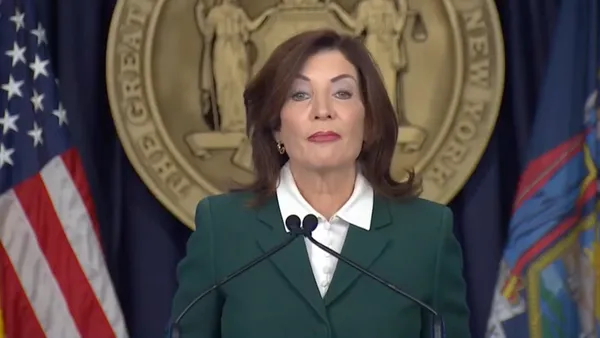
Last July, the New York Department of Financial Services issued a pre-rulemaking request for information regarding the industry’s underwriting process, fee structures and the effect of interest restrictions on BNPL lenders, according to a press release from New York Gov. Kathy Hochul.
That was after Hochul, a Democrat, signed a budget bill last May that included new restrictions related to payments, e-commerce and financial services, including imposing new oversight on buy now, pay later providers. Then in February this year, the state proposed regulations to codify that new law.
In its letter to the department, the AFC urged the agency to consider simplifying consumer disclosures by using real-time electronic account summaries, instead of monthly statements, a change that aligns with current federal regulations.
“Regulatory clarity and consumer protection work best when aligned with the operational realities of financial technology, and AFC strongly encourages NYDFS to refine this framework to keep safe credit accessible for all New Yorkers,” the council’s CEO, Phil Goldfeder, said in the AFC’s release.
If the department implements its proposed rules, the new regulatory requirements could reduce the credit available to New York residents by more than $500 million per year, the trade group said.
The department had allowed 60 days for public comment on its BNPL rulemaking. Those comments were due Monday.
Under the new proposed rules, BNPL providers would be subject to new licensing and supervision, dispute resolution standards, credit reporting requirements, fee caps and data privacy regulations.
“This regulation will govern how Buy Now, Pay Later companies operate in the state, protecting New Yorkers from excessive fees and the misuse of personal data, while ensuring transparent loan terms and a fair process for resolving disputes,” New York Department of Financial Services Acting Superintendent Kaitlin Asrow said in the February release.
Along with New York, other state regulators and lawmakers are more closely monitoring the BNPL industry, with at least one other state passing a law.
In June, Illinois Governor J.B. Pritzker signed the Buy-Now-Pay-Later Loan Consumer Protection Act into law, which established customer refund and dispute-resolution requirements for BNPL companies. While the American Fintech Council remained “neutral” on the Illinois law, the trade group joined other organizations in criticizing New York’s legislation.
The Consumer Financial Protection Bureau under former President Joe Biden had sought to increase oversight of BNPL practices, but the federal agency has pulled back on that regulation under President Donald Trump.
Congress members are still pushing for oversight. Last November, a group of senators, including Sens. Elizabeth Warren (D-MA), Tammy Duckworth (D-IL) and Cory Booker (D-NJ), sent letters to executives at Affirm Holdings, Klarna Group, the Block-owned Afterpay, Splitit, Sezzle, Zip and PayPal Holdings requesting information about their respective loan services, the number of transactions they make using BNPL loans, the average loan size and their number of customers using them.
"The law and regulation will take effect 180 days after the rule is adopted, with an additional transitional period for those already offering BNPL loans in New York," according to the governor's February statement.
It's not clear when the rule will be adopted. Spokespeople for the New York department didn't immediately respond to a request for comment.