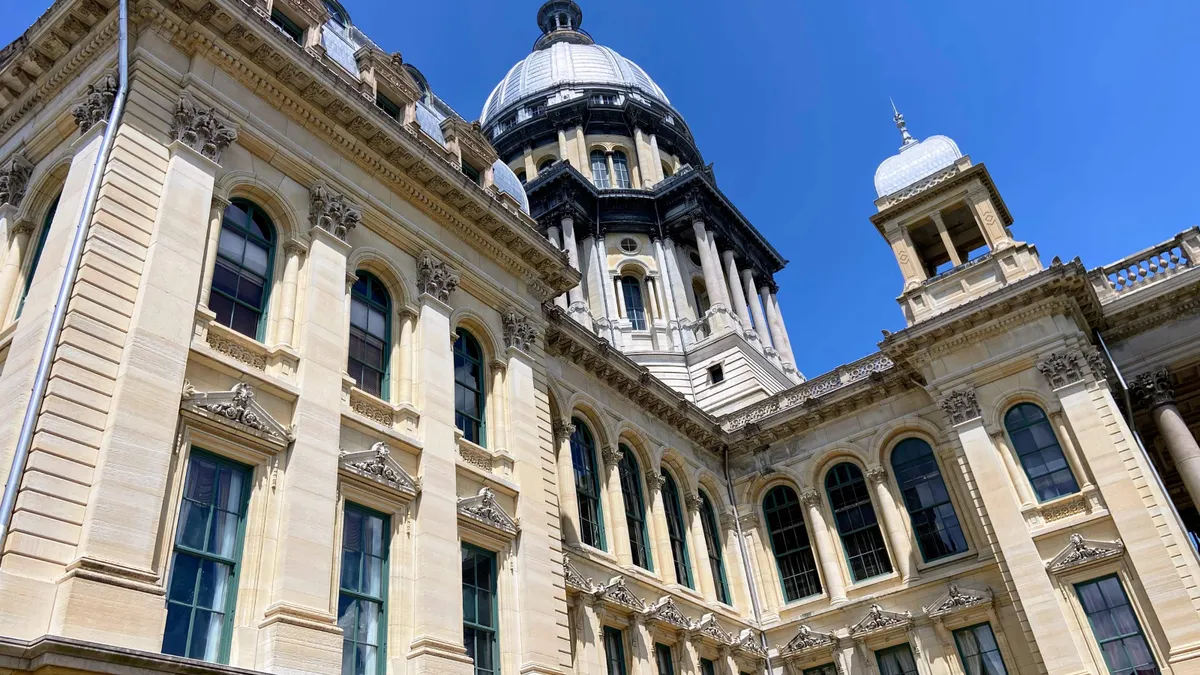
An Illinois bill to license and regulate buy now, pay later providers is similar to a New York law, but hasn’t generated the same level of opposition by the BNPL industry.
Illinois would become only the second state with a distinct law regulating installment loan providers, if Gov. JB Pritzker signs the measure. New York enacted legislation in May 2025 to regulate BNPL lending.
Illinois’ Buy-Now-Pay-Later Loan Consumer Protection Act was formally sent to Pritzker by the Senate on Monday, according to the General Assembly website. It passed the House of Representatives on June 1, following Senate approval last month.
Pritzker is reviewing the bill and his office had no further comment on it, a spokesperson for the governor said Tuesday.
Two trade associations that represent BNPL lenders, the American Fintech Council and the Financial Technology Association, are “neutral” on the final version of the bill, spokespeople for the groups said Monday. The FTA represents several BNPL companies, including Klarna Group and Zip.
“AFC engaged in productive conversations with lawmakers regarding the Illinois legislation, and we ultimately arrived at a neutral position regarding the final bill,” Ashley Urisman, the council’s director of state government affairs, said in an emailed statement.
That stance is a departure from the fierce efforts the BNPL industry waged against the New York law.
Illinois’ BNPL provisions
Several other states, including California and Maryland, license BNPL lenders under existing credit statutes, said Lauren Saunders, associate director of the National Consumer Law Center.
The Illinois bill “is probably an indication of growing interest in states picking up from where the CFPB has backtracked,” Saunders said Monday in an interview.
Under the law, BNPL players operating in Illinois would be licensed and overseen by the Department of Financial and Professional Regulation. The measure – which defines a BNPL loan as one with a term of 120 days or less – also mandates a dispute resolution process and refunds for consumers.
The bill prevents lenders from making a debit attempt on a customer’s account if there are insufficient funds in the account, and limits lenders to two ACH debit attempts for repayment. Regulators may also “limit or prohibit the number of loans any consumer may have outstanding,” according to the bill.
BNPL providers have opposed subjecting their services to the same laws that apply to credit card loans.
The FTA detailed its “concerns” about five aspects of the measure in a May 22 letter to Illinois Rep. Jennifer Gong-Gershowitz, chair of the House Judiciary-Civil Committee.
Among the association’s issues with the bill are the inclusion of consumer dispute rights from the federal Truth in Lending Act, restrictions on account debits and “an APR-based fee cap designed to annualize the cost of credit,” FTA CEO Penny Lee wrote in the letter.
The fee cap “is ill-fitting for closed-end, short-term loans,” Lee said.
Differences with New York
Still, some consumer advocates said the Illinois legislation is more industry-friendly than New York’s law, which regulators are still working to implement via rulemaking.
Illinois’ BNPL regulation appears to be weaker than New York’s law and “falls short on several critical measures,” Adam Rust, director of financial services at the Consumer Federation of America, said Monday. He cited a lack of “clear caps” on financing costs and a “loophole for longer-term loans that could allow lenders to evade supervision.”
“The Illinois law seems more abstract than concrete and granular, and that’s probably something that’s going to make a trade association comfortable,” Rust said in an interview. “They can keep pushing in the rulemaking,” he added, as regulators draft implementing rules.
The bill enables a “120-day loophole” for loans that “makes it easy for lenders to design their products to evade legal oversight” by offering loans of 121 days or longer, the Woodstock Institute said in a May 22 press release.
The BNPL bill also “punts rulemaking to state regulators” for enacting provisions specifying the consumer refunds and dispute resolution processes, the organization said.
The Chicago-based Woodstock Institute is on the AFC's Community Advisory Board and is funded by banks and foundations. The institute describes itself as a “nonprofit research and policy organization in the areas of fair lending, wealth creation and financial systems reform.”
BNPL use surges
The state legislation comes as BNPL loans have gained popularity among consumers.
Last year, six large BNPL providers issued an estimated $157 billion in credit in the U.S., with the industry’s pay-in-four model accounting for about half the total, according to a Federal Reserve Board of Governors report on BNPL lending released this month.
The BNPL industry has seen “substantial growth” since 2019, with pay-in-four loan volume increasing about 80% since the Consumer Financial Protection Bureau last assessed the lending in 2023, according to the June 5 Fed report.
States have gradually increased their oversight of the buy now, pay later industry as the Trump administration has sought to shrink the CFPB.
In December, the attorneys general of seven states, led by Connecticut and North Carolina, requested information from a half dozen BNPL providers, including Affirm Holdings and Block’s Afterpay, about their loans and other business practices.
Under the Biden administration, the CFPB proposed an interpretive rule that would have treated by now, pay later loans like credit card transactions and provided consumers with protections, including the right to dispute charges and request refunds afforded to credit card holders. In March 2025, the CFPB rescinded that rule interpretation.
“State protections and oversight for BNPL loans are especially important now that the Consumer Financial Protection Bureau (CFPB) has been gutted,” the National Consumer Law Center said in a February document outlining New York’s law and predicting other states could emulate it.
Correction: This story has been updated to say that the Woodstock Institute is a member of the AFC's Community Advisory Board and to clarify its funding.