A group of Democratic U.S. senators is seeking information about how the three main credit reporting agencies use data from buy now, pay later companies as BNPL lending grows.
The credit reporting industry has no “standard method” for how to handle BNPL data, the senators wrote in their May 4 letters to the CEOs of Equifax, Experian and TransUnion.
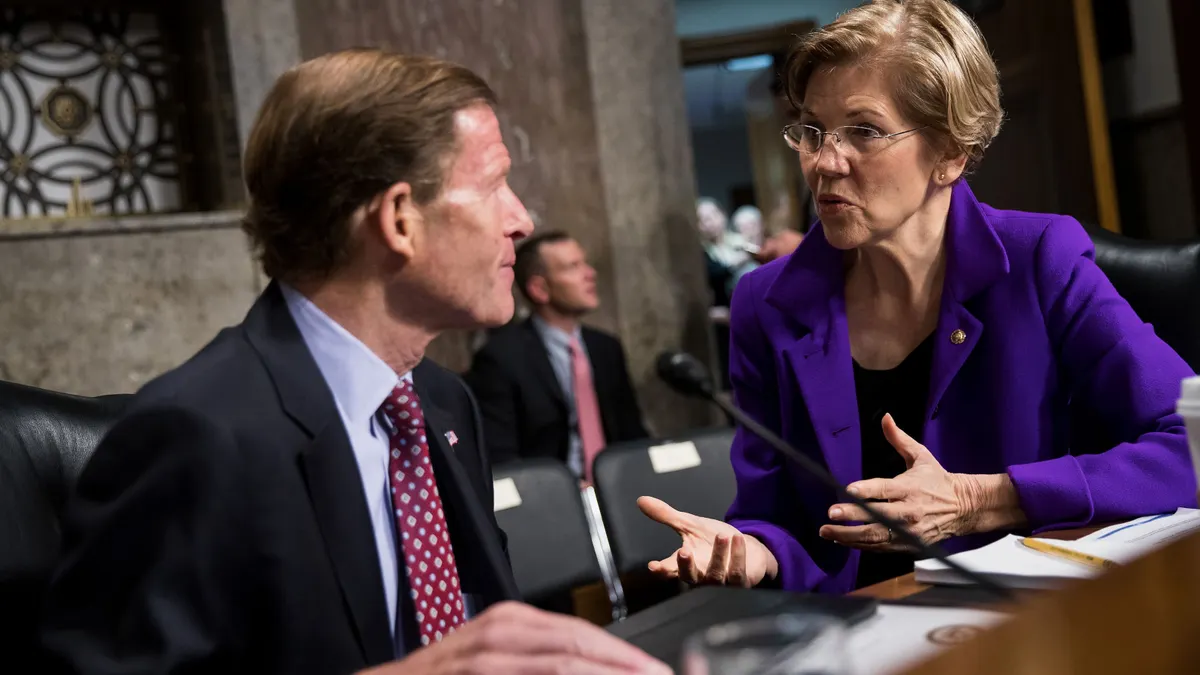
“Given the exceptional growth in the BNPL industry in recent years, BNPL loans are becoming a larger part of consumers’ credit pictures at the same time that Americans are under historic financial pressures,” wrote Sens. Elizabeth Warren of Massachusetts, Richard Blumenthal of Connecticut, Tammy Duckworth of Illinois and Mazie Hirono of Hawaii.
The senators released the letters on Wednesday, and noted them in a press release on the same day. The letters to the credit bureaus follow information requests the same senators sent in November to seven BNPL providers about their businesses.
“All three credit reporting companies currently receive BNPL data from at least one lender with more likely as BNPL continues to expand,” the senators wrote.
BNPL providers have been split about sharing data related to their interest-free BNPL financing and interest-bearing loans to credit bureaus, an issue that has been contentious for years. Industry-wide, it’s unclear which types of BNPL data, and how much, flows to the bureaus.
The Consumer Financial Protection Bureau pointed to the scarcity of such data last year as it tried to assess the impact of BNPL use on consumers, and determine how to regulate the expanding industry. While the federal agency considered oversight during the Biden administration, those efforts were rolled back under President Donald Trump.
“The current infrastructure of credit reporting in the United States is extremely opaque; the credit reporting industry has been very secretive about its scoring models, which presents major, potential consumer protection issues,” the legislators wrote to the companies’ CEOs.
“Until all relevant parts of this industry align on the use of BNPL data, consumers are left in limbo” because information from only some lenders is shared with only some of the credit bureaus, they added.
A spokesperson for Atlanta-based Equifax said in a Thursday email that the company believes “BNPL reporting can play a role in helping people build stronger financial profiles and that consumers should be able to use their responsible BNPL behaviors as a stepping stone to other types of credit.”
In response to an email seeking comment, a TransUnion spokesperson referred to a page on the company’s website discussing BNPL loans. The company said BNPL data is visible only to the borrower “at this time.”
“In the future, this BNPL data furnished to TransUnion may be factored into credit scores and credit decisions,” the Chicago-based company notes.
Experian did not respond to an email seeking comment. The company is based in Dublin with its North American headquarters in Costa Mesa, California.
In 2023, about 54 million Americans used a BNPL product, with an average loan of $135, based on data from a half dozen large BNPL providers, the Consumer Financial Protection Bureau said in a December 2025 report. The bureau queried Affirm Holdings, Block-owned Afterpay, Klarna Group, PayPal Holdings, Sezzle and Zip.
Loan originations surged from about 20 million in 2019 to 336 million in 2023, according to the CFPB survey. The average annual total amount borrowed rose 14%, to $848, from 2022 to 2023, according to the CFPB report.
The senators requested information on which BNPL providers furnish data and whether the data is included in consumer credit reports and scores. They also sought information on each company’s policies on incorporating BNPL data “and under what circumstances" the company would begin doing so.
They also requested information on whether each company has “conducted any any public or private studies about the impact of including BNPL loans on the credit scores of BNPL users.” The senators requested the companies respond by May 18.
San Francisco-based Affirm reports all its loans to Experian and TransUnion, although it notes that lenders can’t see Affirm loans in credit files and the loans don’t factor into consumer credit scores.
“Until all providers report BNPL loans, this will remain a chicken-and-egg problem: credit scores can’t treat BNPL fairly until the data is consistently reported by all BNPL providers,” Affirm says on its website.
Affirm focuses on interest-bearing loans – with 71% of its portfolio in these loans in the first quarter of 2026 – rather than traditional “pay-in-four” financing that is offered interest-free.
Klarna Group, one of the largest BNPL providers, shares data with Experian and TransUnion concerning new, longer-term loans, which it calls pay-over-time loans, according to its website. It also reports on-time payments, late payments and defaults for those loans. Klarna does not report data about its interest-free financing.
Credit bureaus are “still working through their models” and don’t provide a complete view of BNPL use, Penny Lee, CEO of the Financial Technology Association said Thursday in a phone interview.
“There are still concerns from the industry on the accuracy of them capturing buy now, pay later,” Lee said. The FTA represents four BNPL companies, including Klarna and Afterpay.
FTA members “continue to engage with the bureaus,” in terms of studies and pilot programs to assess how BNPL loans are assessed, she said. “They want to make sure that whatever they furnish into the bureaus is done in an accurate way,” Lee said.
The CFPB had been digging into how and whether BNPL players report information to the credit bureaus since at least 2021.
Sezzle CEO Charlie Youakim said in an interview last month that his company considers reporting a matter for BNPL customers to choose.
The Minneapolis-based BNPL company has a program under which customers can choose to have Sezzle report their repayment data as a way to help build a credit score.
“I think the reason the industry’s made it optional is a lot of people have fear about credit and credit reporting,” Youakim said, noting that credit card issuers aren’t required by law to report to credit bureaus.
“They just do it because they think it helps them with repayment” by borrowers, he said of the banks’ reports.
In October, the CEO of the American Fintech Council, Phil Goldfeder, argued that BNPL lenders should share consumer payment information with the credit bureaus and work with them to properly incorporate data from these short-term loans. Affirm is an AFC member.
“Updating credit reporting to reflect BNPL use is a long-overdue modernization,” Goldfeder wrote in an opinion piece.