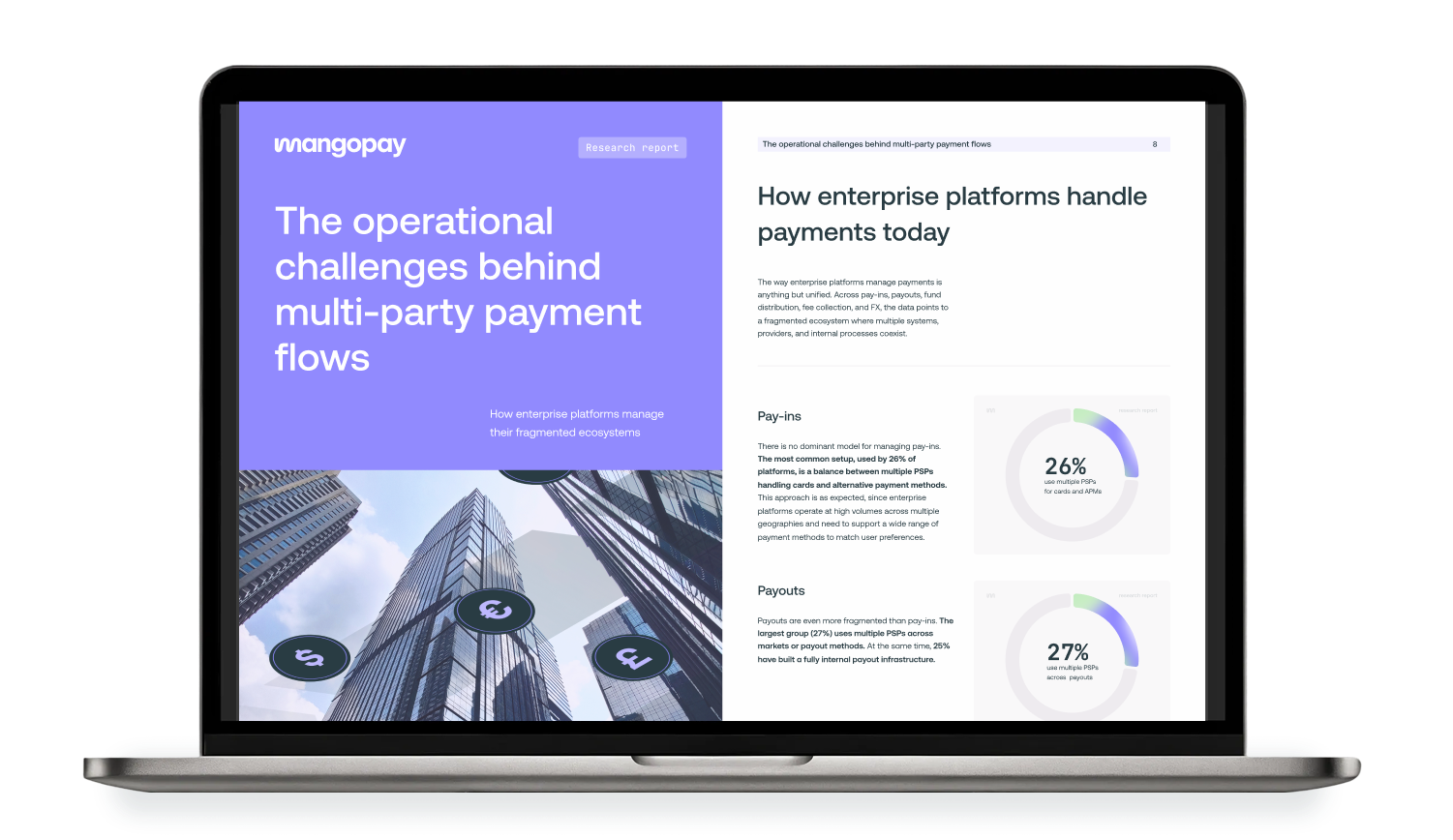
28 April, 2026: Enterprise platforms are managing multi-party payments through fragmented setups, with compliance requirements and manual reconciliation as the main operational challenges, according to a new report from Mangopay.
The report brings together insights from platforms operating across different markets and verticals to understand how they handle multi-party flows, what challenges they face, and what approaches they use to deal with them.
Automation is there, but not across the full flow
Despite ongoing investment in digital transformation and growing focus on AI-based tools, this research shows that payment operations are only partially automated. For 50% of platforms, reconciliation is still mostly manual, with key steps handled by internal teams, while a further 36% rely on fully manual processes, with no automation in place.
At the same time, 54% fully automate cross-border or multi-currency payouts through third-party providers, showing that automation tends to be applied in specific areas rather than across the entire workflow. As an interesting fact, mid-sized enterprise platforms are more likely to report full automation in this area than those processing over 500 million transactions annually.
Compliance drives the highest operational stress
Compliance stands out as the most frequently mentioned challenge (26%) and also the one with the biggest operational and financial impact. When broken down further, this complexity spreads across other key areas such as country-specific payout restrictions (37%), safeguarding (36%), and managing compliance across multiple markets (35%).
Visibility over fund flows is limited
FX is one of the least supervised parts of the payment flow. A large share of platforms (40%) operate with limited visibility over FX rates and costs, discovering the final converted amount only after the transaction is completed. When asked what would have the greatest impact on improving operations, 30% chose better visibility over money flows, which means platforms are focusing on improving how and when funds move, rather than only addressing upstream limitations.
Andy Wiggan, Chief Product Officer at Mangopay, comments, “Operational complexity has become part of running multi-party payments. As transaction volumes increase and businesses expand globally, managing money movement is less about payment processing and more about coordinating multiple providers, currencies, regulatory requirements, and internal systems. What stands out from this research is how much manual reconciliation is still in place, and how limited the visibility over fund flows is. These areas can be improved, but only with a payment infrastructure designed for multi-party flows.
Report methodology
The research was conducted by Censuswide among 600 senior decision-makers across the US, UK, France, and Germany, including C-suite executives and heads of operations, finance, treasury, and payments. All surveyed platforms process at least 50 million transactions annually, in the ecommerce, travel, fintech, SaaS, on-demand services, and crypto sectors. Fieldwork took place between 4 March and 13 March 2026.
About Mangopay
Founded in 2013, Mangopay is the wallet-first infrastructure for multi-party payment flows, designed to give platforms the control, scalability, and revenue opportunities they need to thrive. Mangopay offers programmable wallets that mirror real-world multi-party experiences, enabling platforms to hold, split, and move funds across buyers, sellers, and partners, while unlocking new monetization streams. Mangopay also powers platforms with white-label infrastructure, offering virtual accounts, FX, acquirer-agnostic processing, and fast cross-border payouts, all secured by AI-driven fraud and compliance tools.
With over €150 billion processed, 700 million wallets created, and 350 million users onboarded, Mangopay has demonstrated scale and reliability. Leading platforms like Vinted, Wallapop, Mirakl, and Debenhams have used Mangopay to power complex flows, double transaction volumes, and streamline global operations.