President Donald Trump on Monday reiterated his support for a bill that aims to spur more competition for the dominant card networks Visa and Mastercard with respect to fees they impose on credit card transactions.
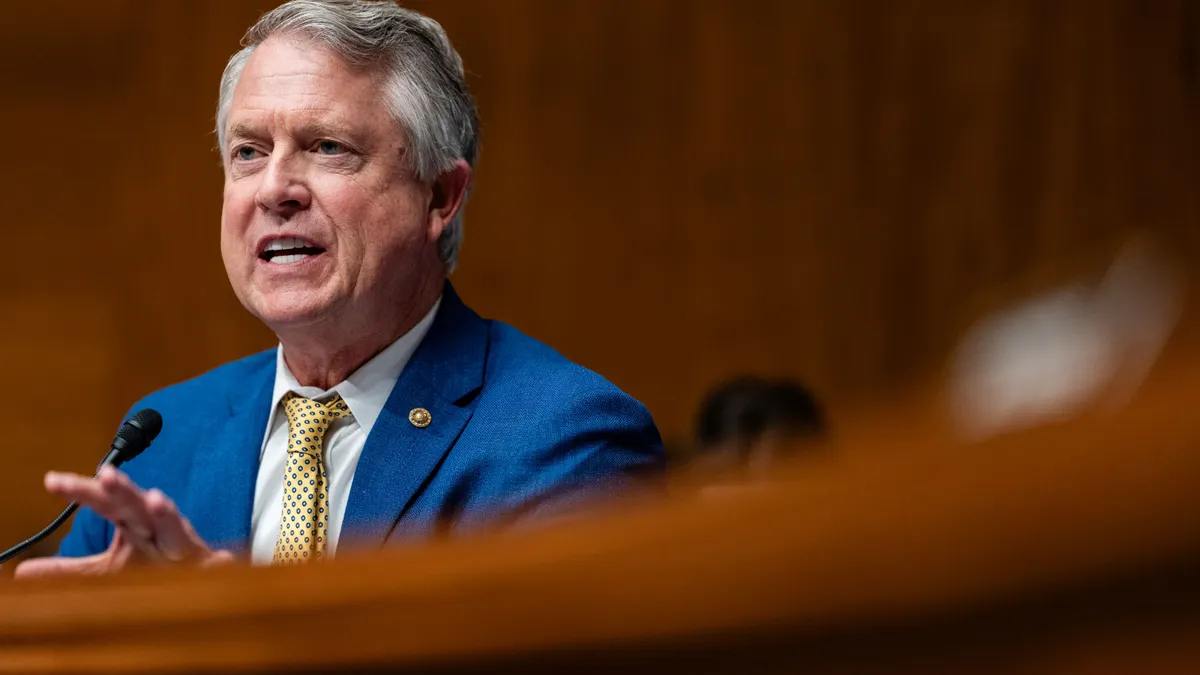
Trump referenced the Credit Card Competition Act in a post endorsing Kansas Sen. Roger Marshall’s bid for a second Senate term. Marshall faces a challenger in the state’s Aug. 4 Republican primary election.
“Roger is working tirelessly to pass the Credit Card Competition Act, in order to stop the out of control Swipe Fee ripoff!” Trump posted Monday evening on his Truth Social account.
Under the bill, banks that issue credit cards would have to ensure that for every consumer swipe there was a network available to merchants for routing the payment that wasn’t Visa or Mastercard.
Such a new law would give merchants at least one alternative, injecting additional competition into a market the two networks dominate. The mandate would apply to card issuers with assets of $100 billion or more.
Trump first expressed support for the card legislation in January, days after also calling for a 10% cap on card interest rates for one year. Trump’s move preceded Marshall and his Democratic co-sponsor, Sen. Dick Durbin of Illinois, to reintroduce their bill.
The consumer-focused efforts came as the administration grapples with how to make everyday expenses more affordable ahead of the midterm congressional elections in November.
The Merchants Payments Coalition, a trade association that seeks to reduce card fees for its members, seized on the social media post to help fuel its battle and thanked Trump for his support. The group also noted that Vice President JD Vance supported the bill when he was in the Senate.
“We welcome the president once again backing this landmark bipartisan bill that would help restore affordability to our nation’s economy,” Doug Kantor, an MPC executive committee member and general counsel for the National Association of Convenience Stores, said in a Monday statement.
The MPC says that card swipe fees have increased 80% since the COVID-19 pandemic, hitting $198 billion last year. The group estimated that merchants would save $17 billion annually if the law passed, citing research from CMSPI, an Atlanta-based payments consulting firm.
A spokesperson for The Electronic Payments Coalition, which represents the card networks and banks, did not immediately respond to an email Tuesday seeking comment.
The EPC has opposed the legislation, which it refers to as “mandates and government intervention.” It contends the edict would harm small business and card loyalty programs, while not delivering savings to consumers.
The bill has faced a rocky path in Congress since Durbin and Marshall teamed up in 2022 to introduce it. In March, the Senate passed a housing bill without an amendment to include the measure, forestalling it from moving forward.