Dive Brief:
- Stripe will enable product purchases within Google’s Gemini artificial intelligence search and app, further expanding agentic commerce efforts, the payments processor said Wednesday.
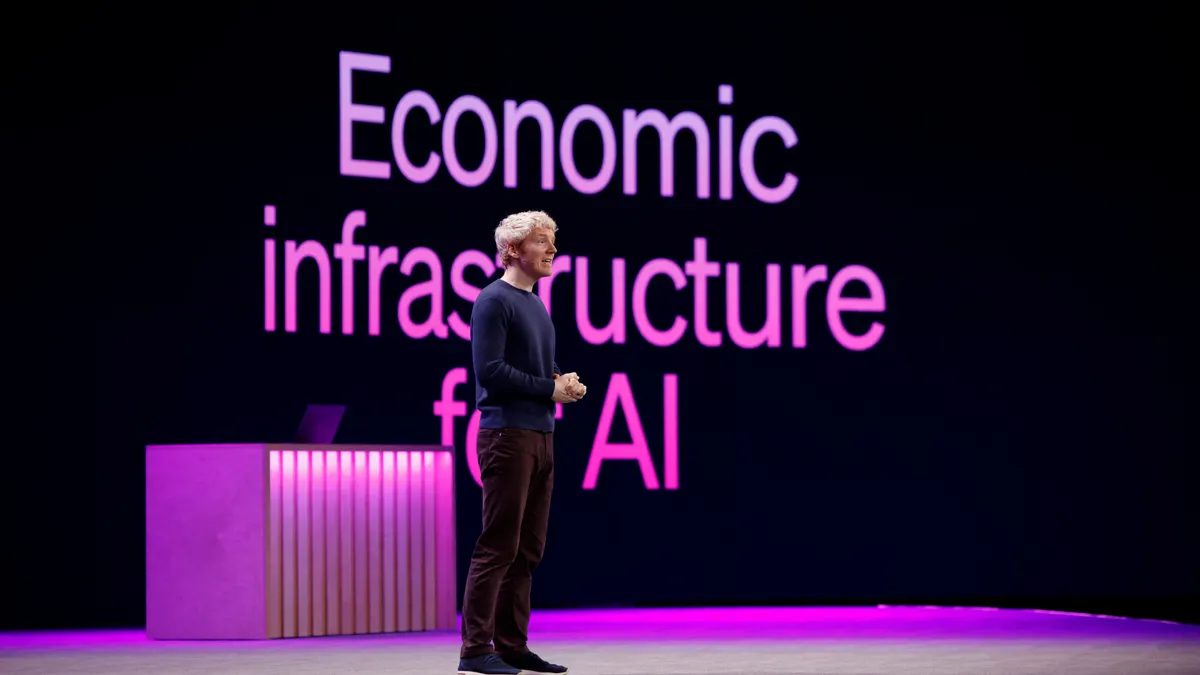
- The company also opened its Link consumer digital wallet to AI agents, allowing users to let the agent make payments on their behalf. The product announcements came Wednesday at the kickoff keynote of Stripe Sessions, the company’s annual event for business partners.
- Stripe CEO and co-founder Patrick Collison opened the event in San Francisco by telling attendees the company has seen a “parabolic rise” this year in new businesses being created on its payment network. “Because of AI, the entire economy is re-platforming: new products, new business models and completely new sectors,” he said.
Dive Insight:
The announcement with Google adds one of the largest AI companies to Stripe’s agentic commerce partnerships since September, when it teamed up with Meta Platforms’ Facebook, Microsoft’s Copilot and OpenAI’s ChatGPT. Those agreements let merchants sell within those tech platforms through an integrated checkout experience.
“It’s easy to underestimate the implications of a near future where agents are autonomous economic actors responsible for most Internet transactions, and just as agents work faster than we do, they’re going to spend money a lot faster too,” Will Gaybrick, Stripe’s president of technology and business, said during the opening presentation.
Google considers the agentic commerce era to be “at the early stages” and is focused on locking arms with merchants and other partners to build agentic protocols that work for the entire ecosystem, Philipp Schindler, chief business officer for Google parent Alphabet, said Wednesday during that company’s quarterly earnings call.
“Our goal is to really remove the grunt work of shopping so that consumers can focus on the enjoyable parts,” Schindler said. For merchants, agentic commerce allows them to focus on retail attributes “beyond just price,” he said, listing customer service, brand loyalty and “removing the friction from the process.”
The Link wallet expansion to agents is designed to give those bots a payment method. The wallet owner approves each purchase, but the agent will be able to then complete a transaction, Gaybrick said.
Stripe also announced that U.S. merchants will now be able to accept stablecoins and Pix – the widely used instant payment system in Brazil – for payment.
Coinciding with the Stripe event, Meta said Wednesday that it has begun stablecoin payouts in two countries, Colombia and the Philippines, through supported cryptocurrency wallets on the Solana and Polygon blockchains. Meta noted that it doesn’t offer “off ramp” conversion of stablecoins into local fiat currency as part of the crypto payments.
The company has partnered with Stripe to oversee administrative functions around the coins, such as custody and licensing, Ginger Baker, who heads Meta fintech and payments, said during the Stripe event. The payouts are expected to expand to about 160 countries by year’s end, Gaybrick said during a brief discussion with Baker at the event.
“It’s just an example of trying to meet people where they are and give them the payment methods and tools that they want,” Baker said.
In terms of the larger evolution of agentic commerce, Baker predicted that “payments will pivot from being a moment to being a policy.”
People will become accustomed to setting rules for their agents, such as spending limits, payment card preferences and limits for different types of spending and then be removed from direct oversight of their payments, she said.
“It feels radical today to suggest that we would just completely give something else permission to manage our financial transactions,” Baker said. “But I think that that’s going to be the reality we’re in.”
Separately Wednesday, cross-border payments firm MoneyGram announced upgrades to its retail network enabled by Stripe technology.
The new solutions include new payment terminals with multiple payment types; tap-to-pay options, including Apple and Google digital wallets; and pay-by-link technology to enable people to complete transactions from their personal mobile device.
The modernization “means connecting our entire global network across retail and digital channels into a single, unified experience for our customers,” MoneyGram CEO Anthony Soohoo said in a Wednesday press release.