SAN DIEGO — Payments players are increasingly counting on artificial intelligence to help fight AI-fueled fraud.
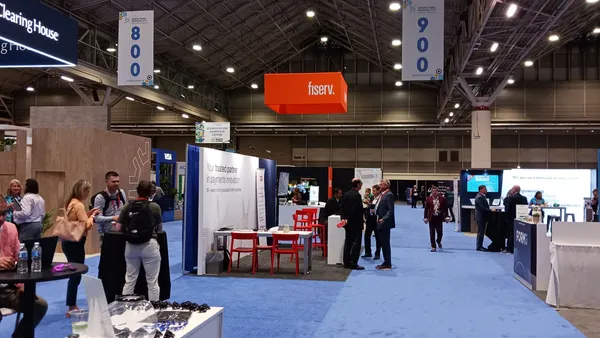
That’s what payments and bank professionals speaking at the Nacha Smarter Faster Payments conference in San Diego said Monday regarding their hope that they can start using artificial intelligence to respond to fraudsters who have sharpened their attacks using the technology.
“The entire environment has completely changed, and we're in a situation where you really need AI to fight AI,” said Matt Vega, who is chief fraud strategist at the anti-fraud and compliance startup Sardine. He said congressional members are weighing legislation that would empower the industry to make more use of AI in battling fraud.
Fraudsters use AI to test and refine their schemes, and then deploy them in a rapid-fire way in the market. That has allowed a scaling of the threat. As a result, cybersecurity and technology executives are reaching for AI tools they hope will enhance their defenses.
“What's happening now with the use of AI, basically, we're starting to see a huge spike in something called polymorphic agentic agents,” Vega explained during a panel titled “The Game-Changing of Influence of AI on Payments.” Polymorphic agentic agents are “AI agents that actually can adapt, based on the controls that you all put in place,” Vega told the audience of bank and payments professionals.
For example, Vega explained how a financial institution client this month began seeing increased automated attacks related to onboarding customers and as a result increased its cyber defenses. Within seconds, the fraudster pivoted in an effort to find a new way to get through the defenses, he said.
Google has seen a push among its financial institution clients this month to better use AI to battle the expanding threats posed by AI-backed fraudsters, said Elizabeth Bourgoin, who is head of banking for the tech company’s cloud services division. Fraudsters “are using these same technologies to interject and get through safeguards and interact with payments processing and find vulnerabilities in platforms,” said Bourgoin, who also spoke on the panel.
To that end, the tech giant just launched a Google cloud fraud defense that will use AI-driven agents to help spot vulnerabilities and patch them. Most of the banks that Bourgoin works with are investing in these types of new defenses, she said. “It really does mean you have to step forward and start to use agents to fight against that,” she added.
Imposing a regulatory framework
In Congress, members of the House Financial Services Committee are weighing how they can help create a regulatory framework that will allow financial institutions to tap AI more easily in the war on fraud, Vega said. The Office of the Comptroller of the Currency and the Federal Deposit Insurance Corp. are joining in to provide guidance on that front, he said.
“The House Financial Services Committee and OCC and FDIC – they are all in, like they are 100% you can do it now, like you absolutely can start using AI agentic agents in financial institutions, heavily regulated institutions,” he said during the panel discussion.
In an interview afterward, Vega declined to comment on which Congress members’ staffers his company has spoken to, but he said there is bipartisan support for a new approach to the regulatory framework to enable AI use.
He said the committee and the federal agencies are trying to build a regulatory “framework that allows for rapid adoption of AI and agentic AI use cases in financial services.” While the regulatory agencies have started to approve the banks’ use of AI, there isn’t a clear framework for AI, he explained. The legislative work is in the early stages, he said, but he expects it to move fast.
Ben Chance, who leads the Certos identity and payment risk services unit at Early Warning Services, wasn't familiar with the legislative action, but backed the idea of imposing regulatory oversight. "This is a very powerful tool, and a very powerful tool should have a regulatory framework around it that allows us to use the tool to make the ecosystem better and combat these criminal enterprises that are fighting us every single day,” Chance said in an interview at the conference.
Adapting to increased fraud
Other speakers on the panel with Vega outlined how the banking industry has to adjust to the new fraud environment.
The industry has to think through how to better protect its payments rails and networks, and it can’t be at the same slow pace that financial institutions have traditionally gone about security, said Joe Fuqua, who is the head of intelligent automation architecture for the bank Truist.
“For larger institutions, it is challenging because we tend to move a bit more slowly, and so we have to learn how to be more adaptive and react more quickly,” Fuqua said, noting that financial services firms generally have “significantly more horsepower, in terms of data and people compared to most of the bad actors.”
The banks will need to make sure their defense systems are constantly monitoring the new threats and adapting to counter them, said Fuqua.
Criminals who are using AI today are competing with financial institutions in their use of the technology, said Greg Williamson, who is head of fraud commercialization strategy at the anti-fraud services provider Nasdaq Verafin. He spoke with other panelists on a separate conference panel discussion titled “Is AI Friend or Foe to Fraud Fighters?”
Williamson explained how his “biggest fear” revolves around the crooks being able to use AI to test and learn more quickly than the financial institutions they’re attacking. He’s also concerned about the “industrialization” of fraud whereby fraud is being perpetrated on a broader scale, he said.
“AI is enabling them to do things much quicker,” said Williamson, who suggested banks can take up to 18 months to pursue a new AI model. “They're able to test, learn and move quickly.”
Dave Excell, the founder of cybersecurity firm Featurespace, explained on that panel how one company he services recently had its call center flooded with AI-generated phone calls in a new type of attack this year.
On the flip side, Excell explained how Featurespace, which Visa purchased in 2024, has tapped AI to better predict what transactions a consumer will pursue based on past transactions, and then to use that understanding to better detect fraud. The company is also using AI to help investigators in their probes and to improve their system’s software strategies, he said.