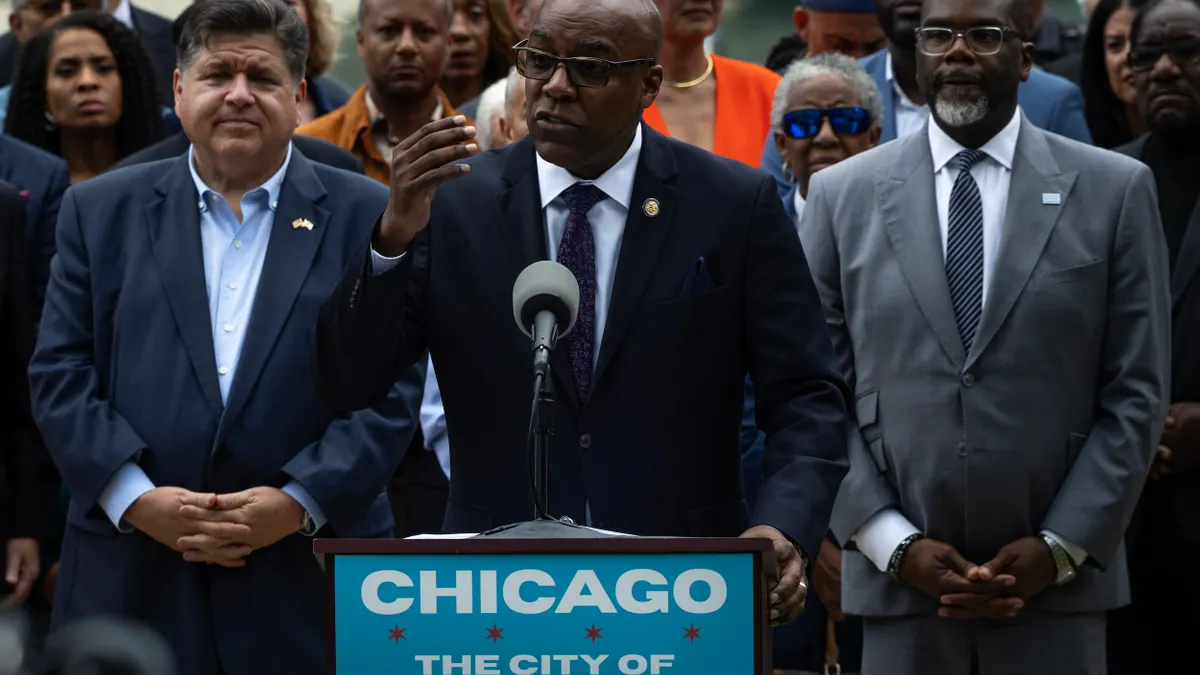
Illinois Attorney General Kwame Raoul pushed back Monday against Trump Administration agencies seeking to stop an Illinois law that would restrict card network interchange fees.
The state’s Interchange Fee Prohibition Act, signed into law in 2024, would limit fees charged by bank card issuers and card networks like Visa and Mastercard, disallowing the fees on taxes and tips. Interest groups representing the banks and credit unions that issue credit and debit cards sued the state to halt the law.
That battle between the state and bank groups has waged in the U.S. District Court for the Northern District of Illinois since August 2024 when the Illinois Bankers Association, the American Bankers Association and other interest groups filed their lawsuit. The case is now before the 7th Circuit Court of Appeals after the lower court judge ruled in favor of the bank groups earlier this year, pointing to new federal rules that preempted the state law.
Interchange fees are charged to merchants, like retailers and restaurants, every time a consumer swipes a card to pay for a transaction. Merchant groups have been fighting the banks and card companies for decades, in court and in Congress, in an effort to lower the fees.
In an appellate court filing Monday, Raoul’s office reiterated the state’s prior arguments backing the soundness of the state’s law and countering U.S. District Court Judge Virginia Kendall’s ruling as “badly flawed.”
Specifically, the AG contended that her decision was based on “invalid” federal rules that the Office of the Comptroller of the Currency and the National Credit Union Administration issued earlier this year in reaction to the Illinois law. The rules are invalid because the federal agencies didn’t follow proper procedures for issuing the regulations, Raoul’s office said.
“OCC’s and NCUA’s interim final rules are invalid because the agencies failed to undertake notice-and-comment procedures before issuing them, and no ‘good cause’ justifies that failure,” the AG’s court filing said.
Raoul also asserted Kendall’s contention that the state should have challenged the rules under the Administrative Procedure Act was faulty reasoning.
“That Illinois has not separately filed an APA action seeking vacatur of the rules is irrelevant because only a valid federal law can preempt a state law, and a federal regulation is invalid if it was not issued pursuant to the APA’s procedures,” the AG’s brief said.
Spokespeople for the OCC and NCUA didn’t immediately respond to an emailed request for comment on the AG’s filing.
A coalition of nine trade associations in turn sued the Office of the Comptroller of the Currency and the National Credit Union Association this month over the agencies’ decision earlier this year to preempt the Illinois law.