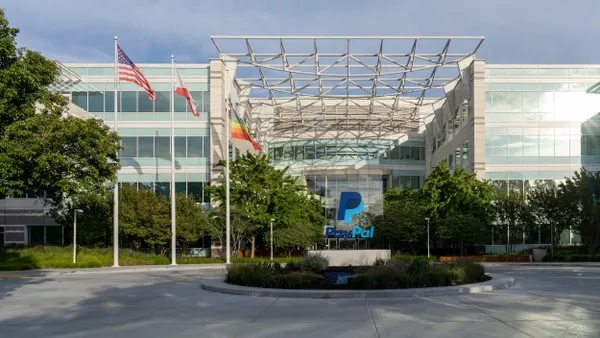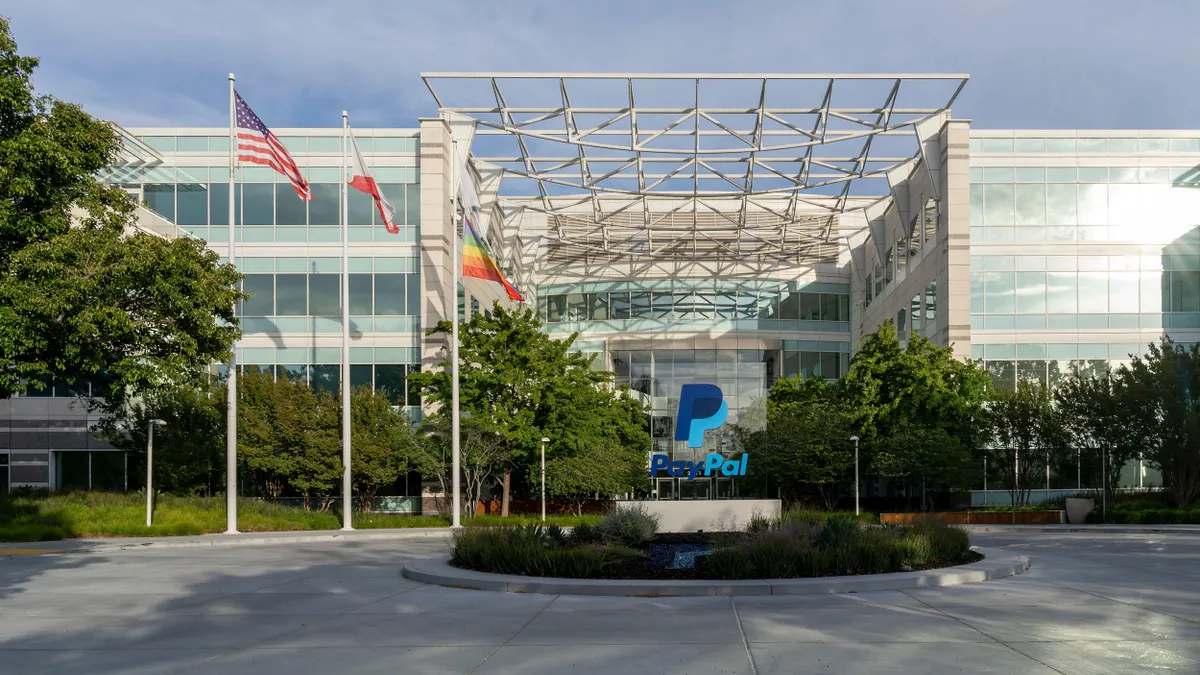
PayPal Holdings has eliminated an unknown number of jobs this week, just days after reports that a possible sale of the company, or assets, wasn’t going to materialize.
Employees from across PayPal’s operations posted publicly on LinkedIn over the past 24 hours that their jobs had been eliminated, or that they had had their final day at the San Jose, California company.
The employees cut included a director in PayPal’s Braintree unit who had been with the company for 22 years; a commercial manager for the company’s buy now, pay later financing and other payments; and an executive producer for its corporate events who said her job was eliminated as part of a “global restructuring.”
An account manager servicing PayPal’s large corporate clients lamented the loss of colleagues and praised their work alongside him in his LinkedIn post. “I’ve been incredibly fortunate to work with some of these people,” that manager said. “We’ve celebrated wins, chased down escalations, survived quarter-end, dealt with the occasional ‘this needs to be fixed yesterday,’ and probably spent way too much time on calls that could have been emails.”
A spokesperson for the company said that the worker cuts were part of a cost reduction plan previously announced in May, declining to comment on the number or percentage of employees affected by the headcount decrease.
“The recent staffing changes are part of our previously announced multi-year transformation to simplify our global operations, strengthen execution, and position the company for long-term growth,” the spokesperson said by email Tuesday. “Decisions like these are never easy. We recognize the impact they have on our employees and are committed to supporting them through this transition.”
The reduction comes in the wake of an abandoned sale of assets to PayPal’s younger digital competitor Stripe, which had teamed up with the private equity firm Advent International to consider a deal, but ended their pursuit, according to reports last week.
They were reportedly willing to buy PayPal for $53 billion, according to a July news article from the media outlet Reuters and other media companies, after an initial approach in April. Some coverage also noted other separate, potential suitors, including the payments player Block and tech giant Apple as well as big banks.
Employees had been streaming out of the company in the months before as well. For instance, PayPal’s global head of payments markets and partnerships left in May to join the bank JPMorgan Chase as its chief commercial officer for merchant services and payments, according to his LinkedIn profile.
And this isn’t the company’s first round of whittling its workforce. PayPal also cut an undisclosed number of employees last year and about 9% of the workforce in 2024.
As digital payment plays that PayPal helped invent more than 25 years ago have become an increasingly attractive business play for fintech startups, the company has faced more competition from more established players like Apple Pay as well as new entrants, such as BNPL rival Klarna.
While PayPal’s legacy brand has aged and faced more competition, its Braintree unit has experienced increasing demand for services from its large company clientele, but it has struggled to increase its profit margins. Meanwhile, the company’s peer-to-peer tool Venmo, which is popular with a younger set of consumers, has had trouble monetizing its services.
For his part, PayPal CEO Enrique Lores warned last month after the company reported second-quarter results that there was “significant work ahead,” on his LinkedIn page. Lores, who took the top post in March after serving on the company’s board, has been trying to set the company on a new course, with high profits and better prospects for growth.
Lores took over from Alex Chriss, who was appointed in 2023 and had also struggled to fix some of the company’s growth problems and financial constraints, as had his CEO predecessor Dan Schulman.
Lores has been counting on financial services, such as the company’s BNPL financing services, as well as increased Venmo adoption and use, along with some other services, to drive growth, he said during the company’s earnings conference call with analysts in July.
Still, he had noted that cost reductions were also required. The company said it was seeking $400 million in cost savings on a run rate basis by the end of this year, showing up more significantly in the fourth quarter, the company’s chief financial officer, Jamie Miller, told analysts on the call.