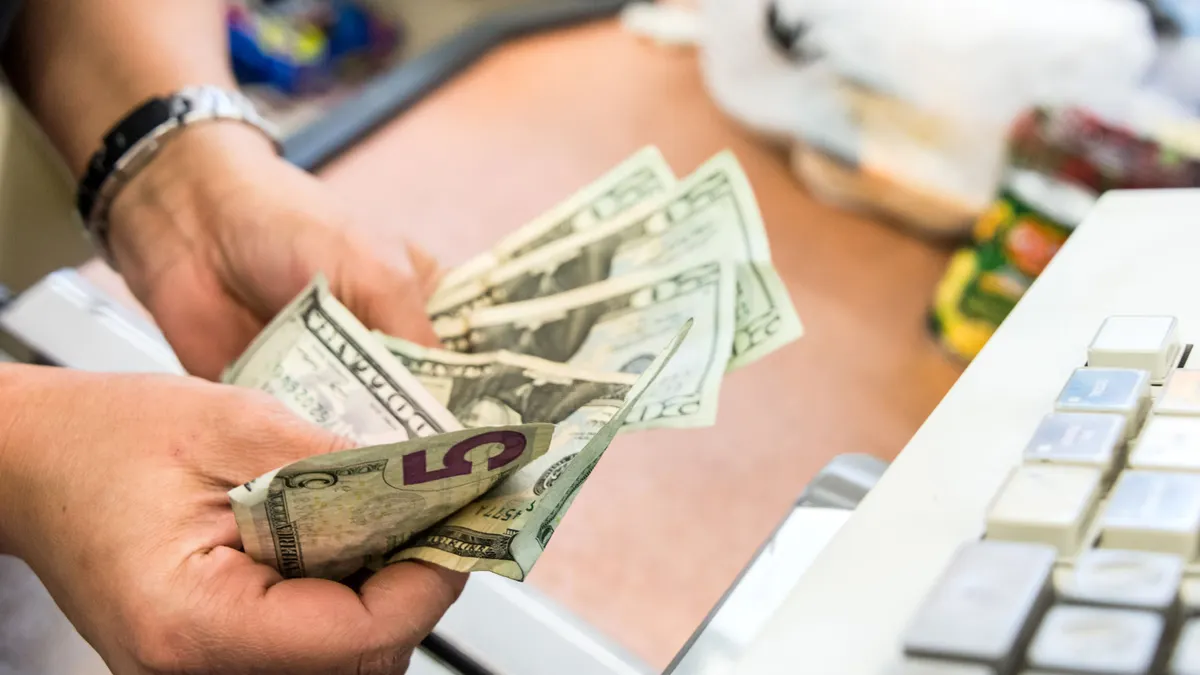
The days of cashless businesses are coming to an end in Illinois.
On July 31, Governor J.B. Pritzker signed House Bill 4592 into law, which bars companies from refusing to accept cash for purchases valued below $500.
The law also prohibits companies from posting signs stating that they don’t accept cash and bans businesses from charging customers higher prices for paying with cash than for other forms of payment.
Consumers shouldn’t be required to use digital payments, one of the bill’s sponsors, Illinois Sen. Li Arellano, Jr., explained in an interview this week.
“We don’t want to force people to become part of payment structures or financial systems, especially ones that take a percentage of everybody’s pay and make everybody’s life get more expensive,” Arellano said in the Wednesday interview.
The law, which takes effect Jan. 1, 2028, applies to gas stations, grocery stores, pharmacies, restaurants, retailers and self-service checkout.
Violators of the act will face up to $5,000 fines per calendar year, starting with up to a $50 fine for the first violation, a $100 fine within the first 12 months of the first violation and $500 for the third and every violation after the first two, according to the law.
Illinois State Rep. Rita Mayfield introduced the bill in January, and State Sen. Christopher Belt became the chief sponsor in April. Along with Arellano, State Rep. Carol Ammons and State Sens. Doris Turner, Jason Plummer, David Koehler and Mark Walker co-sponsored the bill.
Though Arellano supports alternative payment options for consumers, including credit cards, payment apps or Bitcoin, he said consumers’ choice of cash shouldn’t be limited. With credit cards, the interchange and other fees merchants must pay to accept them may lead to higher prices for goods, eventually driving up the cost for everyone, he said. The new law aims to prevent consumers from being pushed to use cash alternatives, he said.
While the fines are aimed at deterring businesses from violating the law, the fines start small and progress higher to avoid excessive enforcement, Arellano said, adding that the law doesn’t aim to generate revenue for the state.
“The goal is not to punish people,” he explained. “The goal is to find compliance and continue to tweak the laws to make sure that compliance we’re seeking is reasonable.”
Plummer had been working on this effort in Springfield, Illinois for four years, he said by email this month. The goal of the bill was to “create a win-win, balancing commonsense consumer protection, individual rights, and appreciating the complexities of running a business,” Plummer said. “I think we achieved our goal.”
The bill faced some opposition from “governmental groups,” Plummer said, but overall, the business community was “great to work with.” In the end, legislators worked to ensure that the law included “reasonable exceptions and flexibility to address practical concerns for all parties,” he added.
“The world is becoming increasingly digital, and I want to make sure this transition does not increase the power of government in your life, and that such a transition does not negatively impact individual rights,” Plummer said in an email.
Mayfield and Belt could not be reached for comment.
“Cash is still necessary for many working people and seniors across our state,” Belt said in a press release. “This law ensures no one is turned away from making a purchase because they choose to pay with the money they have in their pocket.”
Illinois joins a growing list of states seeking to support the option of cash payments. In 2024, Florida’s state legislature introduced a bill requiring businesses to accept cash and other forms of payment for goods and services. A year later, New York’s state legislature passed a bill banning retailers from turning down cash payments.
Along with states proposing bills requiring retailers to accept cash, the issue had gained some traction at the federal level. In 2023, members of Congress introduced bills in the Senate and House prohibiting retailers from rejecting cash payments. House Reps. Donald Payne, Jr., (D-N.J.) and John Rose (R-Tenn.) introduced the measure in their chamber, Sens. Bob Menendez (D-NJ) Kevin Cramer (R-ND) offered companion legislation.
Though other forms of payment, from peer-to-peer payments to cryptocurrency transactions, are becoming more popular, some Americans continue to rely on cash. Credit and debit cards are the top two preferred payment methods among U.S. consumers, with cash ranking third, according to the Federal Reserve Financial Services’ annual Diary of Consumer Payment Choice survey released in May.