Dive Brief:
- Behind credit and debit cards, cash was the third most-preferred payment option (16%) among consumers, according to the annual Federal Reserve Financial Services Diary of Consumer Payment Choice.
- Cash held its third-place spot among payment methods for the sixth year in a row, the survey found. Debit and credit cards comprised two-thirds of U.S. consumers’ payments, according to the survey, which was released May 11.
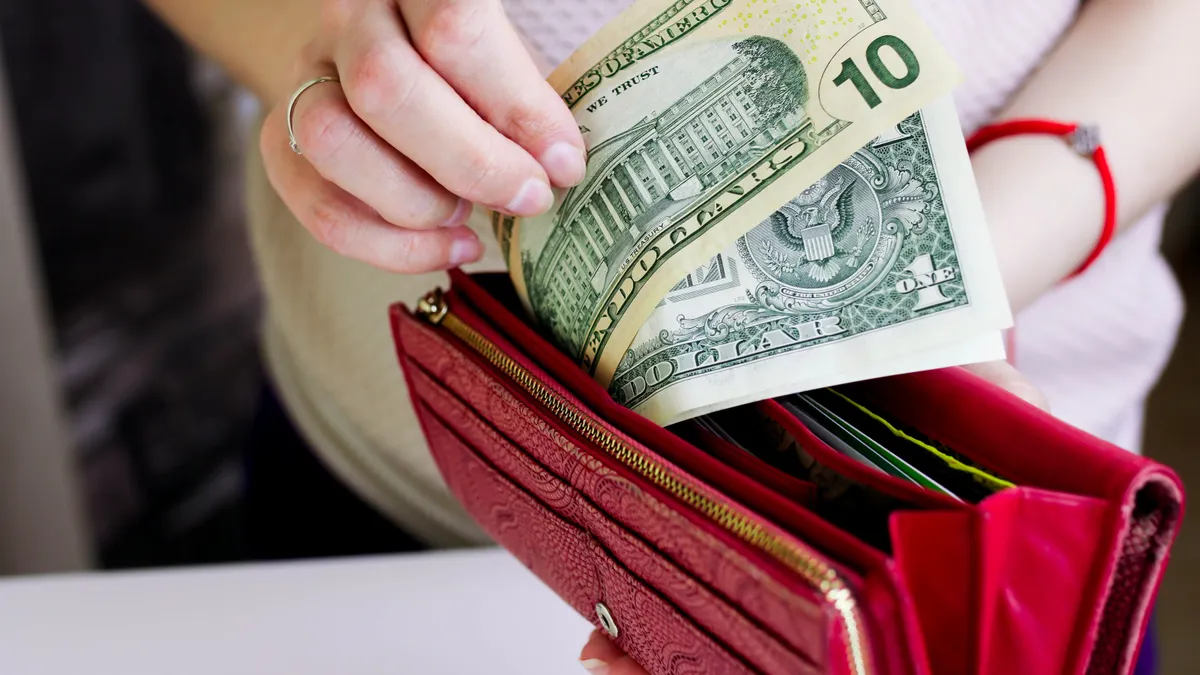
- Over three-quarters (76%) of survey respondents carried cash as a backup payment option. On average, they carried about $69, in line with previous survey findings.
Dive Insight:
The Federal Reserve’s survey offers insights with respect to consumer cash use, even as other payment types gain greater usage. Cash use is particularly popular among older consumers, low-income households and rural residents, the report showed.
Survey respondents aged 55 or older made 10 cash payments per month on average, surpassing consumers aged 18 to 24 who only made two cash payments per month. Meanwhile, households with incomes below $25,000 were more likely to use cash than those with incomes exceeding $150,000, the survey found.
While urban and suburban dwellers paid for their purchases with cash six times a month on average, rural residents did so nine times monthly, the Fed survey found.
Though the Fed’s findings suggest that some consumers are carrying cash, other reports indicate that many consumers are veering away from the classic payment method.
In 2024, the share of consumers who had recently made a purchase with cash in October 2024 dipped to 83% from 87% the previous year, according to a 2025 report from the Federal Reserve Bank of Atlanta. The share of consumers who paid with checks also declined to 35%, down from 40% the year prior, according to the survey.
As some consumers rely more on cash than others, regulators are compelling companies in certain regions to accept the payment method as some businesses go cashless.
In March, New York Attorney General Letitia James reminded the public and local businesses of a new state law barring retailers from declining cash payments for goods and services. Though there are some exceptions, violators could be fined $1,000 for the first infraction and $1,500 for each subsequent violation.
Along with the inequality issues arising from declining cash usage, some argue that the decline in cash could pose problems for climate and natural disaster survivors.
Jay Zagorsky, clinical associate professor of markets, public policy and law at Boston University, noted that electronic payments are vulnerable to such disasters, because they rely on computers, electricity and telecommunications systems.