Dive Brief:
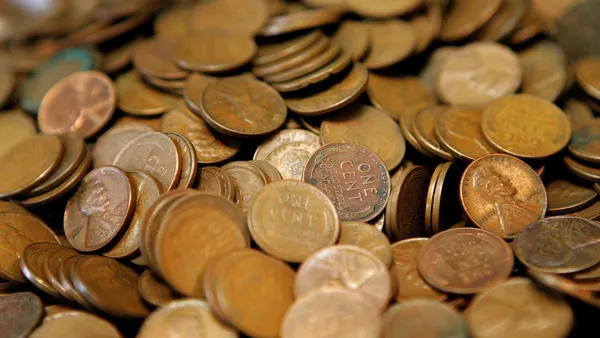
- New York’s attorney general on Friday put retailers on notice that they must adhere to a new state law that prohibits them from declining customers’ cash payments for goods or services, effective Saturday. Under the new law, retailers also can’t charge customers who pay with cash more for a transaction.
- Attorney General Letitia James’ office issued a press release Friday reminding businesses and consumers of the new law and noting civil penalties of up to $1,000 for a first-time violation of the statute, and $1,500 for a subsequent violation, though there are some exceptions.
- “New Yorkers have a right to service no matter how they choose to pay,” James said in the notice. “Businesses cannot deny New Yorkers access to necessities like food and clothing by refusing to take cash, or charging shoppers more for paying in cash.
Dive Insight:
The new law, passed by the state’s legislature last June, echoes a New York City law that took effect in 2020 amid the start of the COVID-19 pandemic when there was a mass rush to digital alternatives for payments as physical stores closed down and consumers turned to e-commerce. Cash also fell out of favor during the pandemic because people sought to avoid exchanging touched items, like cash, given unfounded fears it might carry the virus.
On the flip side, digital forms of payment, including digital wallets like Apple Pay, have been gaining more acceptance, both in e-commerce marketplaces and for in-store checkout.
The digital trend was helped along last year when President Donald Trump signed an executive order pushing the federal government to stop using paper checks. The March 2025 edit was part of a broader campaign to modernize the country’s payments system and reduce costs, delays and fraud.
Still, some lawmakers have been conscious of trying to preserve the use of cash partly because it’s a more common method of payment for minority and elderly consumers who don’t have access to a bank account. U.S. Rep. Donald Payne, Jr., a New Jersey Democrat, introduced a bill in 2019 and reintroduced it in 2021, and by 2023 such legislation had bipartisan backing in the House and the Senate. The bill, referred to as the Payment Choice Act, was reintroduced last year as well.
A Boston University profes sor, Jay Zagorsky, has also argued that cash is essential amid climate change prompting more natural disasters because such storms can cause power outages that make it impossible for people in devastated areas to use digital forms of payment. He also cites armed conflict as an ever present threat that provides another reason for keeping cash as a viable alternative to digital options.