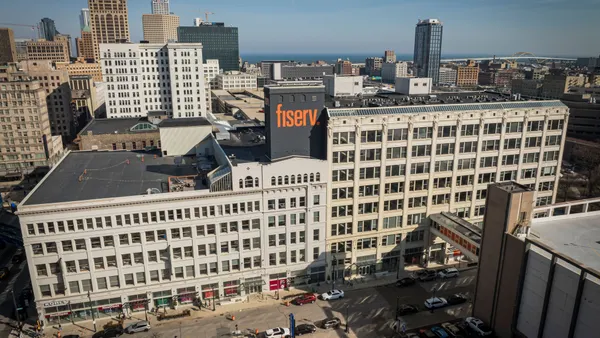
Fiserv has exited two business units this month, including the sale of its student loan business.
Chief Executive Officer Mike Lyons said this week that more deals could follow as his management team reshapes the payments processor’s business.
Fiserv’s strategic business review is a way “to sharpen and make sure we get capital both to the right products for our clients and, obviously, back to our shareholders,” Lyons said Tuesday at JPMorgan’s Global Technology, Media and Communications conference in Boston.
Lyons disclosed the sale of Fiserv’s Education Solutions business, which processes student loans, during his appearance at the JPMorgan event. The buyer is Infinite Computer Solutions, an IT services and engineering company based in Rockville, Maryland, a Fiserv spokesperson said Thursday in an email.
Lyons described the education unit as “very good business, but not strategic to what we do overall.”
Fiserv expects only “minimal impact” to education clients and normal business operations until the sale closes, the Fiserv spokesperson said.
In 2022, Infinite purchased Fiserv’s systems integration services unit and operations in Costa Rica for an undisclosed sum.
The loan-servicing unit sale came five days after Fiserv announced it is spinning off its ATM and cash services business as part of a joint venture managed by Bridgeport Partners, a New York-based private equity firm. The venture includes Fiserv’s ATM managed services, cash and logistics businesses, with Bridgeport assuming operational management when the deal closes.
Fiserv declined to disclose financial terms for the transactions, per the spokesperson.
Separately, Lyons said Tuesday that Fiserv is working to restore relationships with its banking customers. The company has collected feedback from financial services clients that covers three primary areas, he said.
Basic daily service among banking clients “fell short of what their expectations were,” the CEO said. “We’ve rebuilt a lot of the day-to-day service,” Lyons said. “That was a significant investment for us, not just people on the ground, but re-embracing the consultant community.”
In September, Fiserv acquired Smith Consulting Group to provide banks and credit unions deeper technical expertise.
Financial services clients also wanted better on-time product delivery, and many expressed consternation about Fiserv’s decision last year to trim its core technology services platforms from 16 to five, Lyons said at the JPMorgan event.
That change was “an unexpected event for some of them,” pushing them to consider switching their core systems, he said.
Fiserv has no “forced conversions” as it streamlines its core platforms and has adopted a “journey approach” with banks and credit unions to help them evolve their technology more gradually, he said.
“It doesn't have to be as a major event as it has been in the past,” Lyons said of the core conversion process. “We can help clients modernize along the way by taking a more modular approach.”
Fiserv is also seeking to improve attrition levels among financial services clients, a process the company says will play out from 2027 to 2029, when the company expects lower client attrition in line with historical levels.
“These are long tails on these contracts, so we are suffering today from certain events that happened maybe two, three, four years ago,” Lyons said.