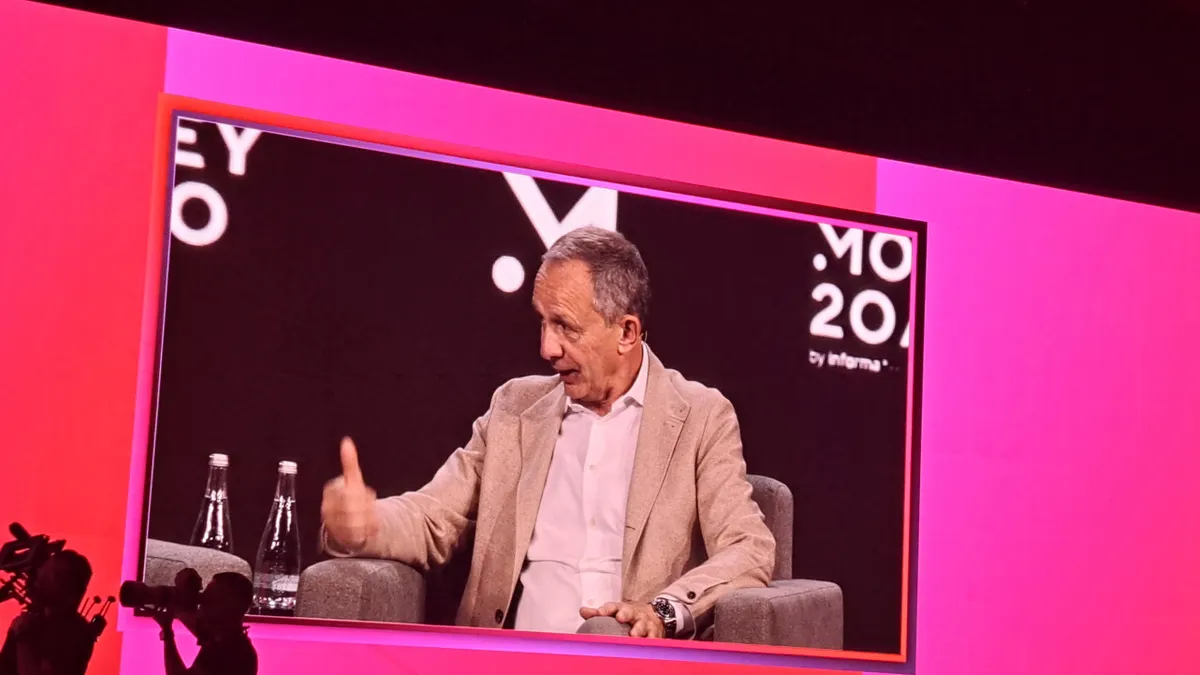
Avik Chatterjee is Capital One Financial’s managing vice president overseeing payments, specifically with responsibilities for the bank’s technology related to enterprise money movement platforms.
He is also the bank’s divisional chief technology officer for enterprise payments. That includes the infrastructure for card, auto loan and banking business payments as well as managing teams that have purview for payment rails and applications moving money in and out of the bank.
In an interview late last month, he spoke about how the bank is pursuing the modernization of payments for its corporate clients as it adapts to industry trends, especially the shift toward real-time payments.
Chatterjee also shared what developments he expects as the bank prepares for the further evolution of payments, including how artificial intelligence is helping combat fraud.
Editor’s note: This interview has been edited for clarity and brevity.
PAYMENTS DIVE: Given your role, what developments are you watching with respect to stablecoins, agentic commerce and digital wallets?
AVIK CHATTERJEE: Digital currencies [and] stablecoins are definitely interesting new innovations in the space that we find ourselves in, and we're always keeping an eye out on how does that create valuable experiences for our customers, and so my role is to basically provide the solutions as the businesses require them. We serve the different lines of business: retail, commercial, small business, and so, as needs evolve, we are definitely keeping an eye out on the trends.
What other trends are you watching for 2027?
The general theme seems to be, how does banking and money movement keep pace with the needs of the customers in the market that we find ourselves in, and from that perspective, it is definitely a move from more latent rails, like the ACHs and the wires – wires are obviously not as latent depending on the time of day or the day of the week, but from those rails, we are seeing a shift into more real-time based payments.
What is becoming interesting is how can some of these financial institutions and banks be prepared for this move to real-time. If you think about traditional banking operations, there was this notion that you can shut down the money movement rails for a certain time in the day – whether it's the end-of-day activities, maintenance activities, or issues and incidents that happen unbeknownst to us – and that kind of operation does not lend itself into the adoption of real-time applications, or real-time payments.

How much has the bank invested in modernizing its operations, and has it moved away from the COBOL operations that still are part of some U.S. banks’ infrastructure?
Those COBOL systems and mainframes are alive and kicking in [the industry]. Maybe not kicking, but they're alive. These are complex systems. There are operations built around it…
What I see is modernization investments are being done across all major banks. I think we are further ahead because of our declaration of building all the software within Capital One on the public cloud, which was built natively. For example, the FedNow and the RTP rails that we built are end-to-end on the public cloud on Amazon Web Services infrastructure, which means that they were built in the modern stack itself. We didn't have to migrate any legacy flows to meet these rails. When we talk about ACHs or wires, though, we still have investments to be made.
So, in my space, I still see there is a difference of maturity in terms of systems that are modernized, [and] systems that are on the path to be modernized. But one of the good things about Capital One is we are always making those investments.
I, unfortunately, cannot talk about exact dollar values in terms of how much is left versus how much has been done, but suffice to say, it is one of the goals for us to have all the rails, not just the real-time rails, run fully end-to-end on a modern cloud-native infrastructure.
How are you meeting clients’ needs for artificial intelligence?
We cater to small business and commercial customers, so AI helps lift all boats from that perspective. For example, we have debit cards which my teams manage, launch and run, and there are debit card programs for our retail customers as well as our small business customers. For both of those cohorts of customers, I think where AI helps is fraud detection in the two seconds that we can make a decision on these transactions. We continue to refine our models to make sure that there are less false positives, [and] higher approval rates for the transactions when the customer actually swipes or taps their card.
You raise an important issue, which is fraud. Anything new in particular you're planning with respect to fraud in 2027, like any new approaches related to AI models?
The industry, and the landscape, are definitely evolving, and so are our fraud models. It takes a while for new patterns to be understood and models to be created against them. The good news is that we have invested a lot in terms of our data infrastructure, which is the foundation on which we can build these new fraud models. We are invested in creating data products, which gives us a very structured, well-managed way of exposing the data layer into the models’ layer. Therefore, we can create these models at a much faster pace by looking at the data trends that we are seeing in the industry.