Checks became a major topic of discussion this month at an annual payments conference that one attendee referred to as the industry’s all-star game.
No, it wasn’t Money20/20, which took place last week, but rather the Chicago Payments Symposium. The latter is hosted by Federal Reserve Financial Services, the division of the central bank with purview for payments and innovations like the instant transfer system FedNow. It takes place at the Chicago Fed and this year occurred on Oct. 13 and 14.
It’s really the “opposite” of Money20/20, said Deborah Baxley, a partner at the consulting firm PayGility Advisors in Rye, New York. It’s not large, about 150 attendees, and everyone is gathered in a theater-style auditorium with microphones at every seat for discussion with the speakers, and “classy” catering at a reception cocktail party, she said in an interview last week.
By contrast, Money20/20 draws thousands of attendees to The Venetian Resort Las Vegas, with conference-goers dispersed to multiple stages for a frenetic schedule, with casinos as a backdrop for the event. Another difference is that the Fed event is invite-only with press barred from attending, while Money20/20 feeds on generating attention, business and publicity for the fintech industry.
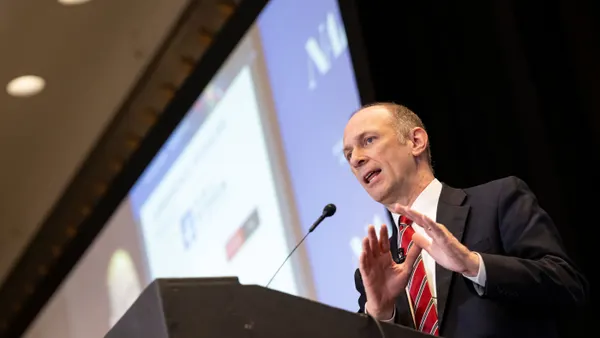
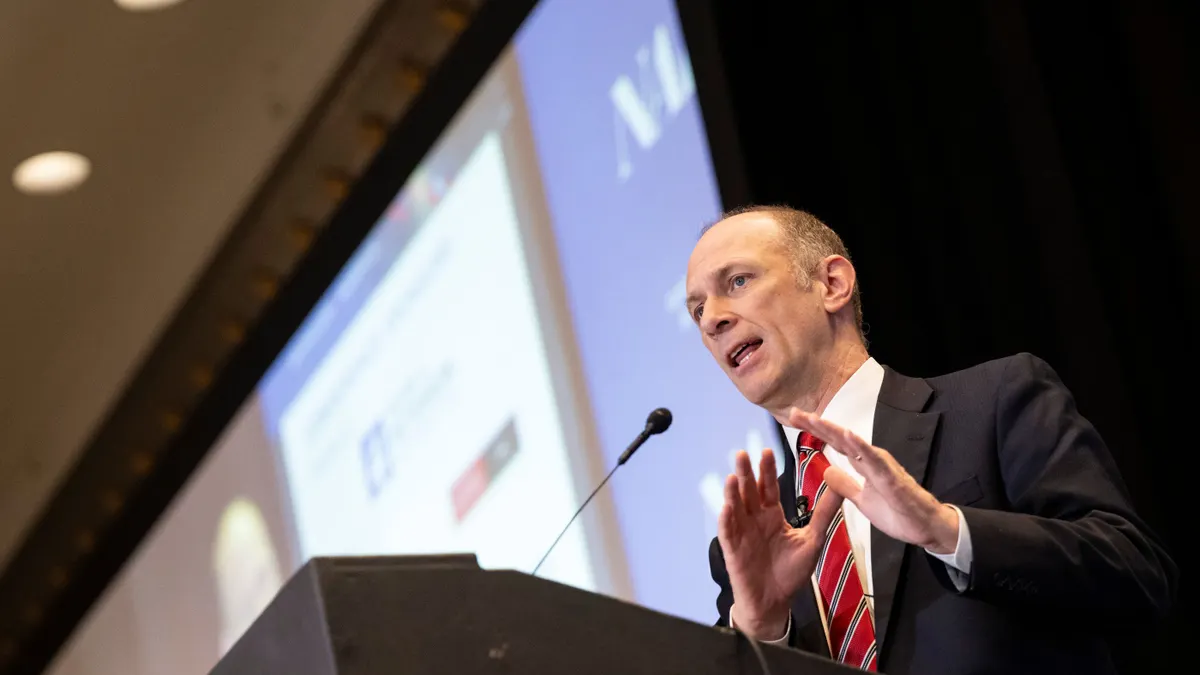
While the star speakers at Money20/20 were the CEOs of major companies, including digital payments player PayPal Holdings and AI search tool company Perplexity, the Chicago Payments Symposium’s celebrity was Chicago Federal Reserve President Austan Goolsbee, the former economic adviser in President Barack Obama’s administration.
The more sedate symposium this year generated a lot of discussion, perhaps coincidentally, about an old school payments method: the paper check. It became a bit of a “running joke” at the event as checks kept cropping up in discussions, said Baxley, who was attending the symposium for the third time.
While all the expected digital payments topics were on the agenda – stablecoins, agentic transactions and real-time transfers, it was the paper check that kept cropping up, somewhat unexpectedly. It happened so frequently people started mentioning the antiquated paper payment instrument in jest too, Baxley said in an interview last week.
It all started when checks took center stage during one of the early panel discussions on why there hasn’t been more adoption of real-time payments, Baxley explained. That turned into a conversation about how “organizational inertia” is sustaining checks as a major form of payment for small businesses, partly because they’re unwilling or unable to invest in technology upgrades, she said. It was noted that checks are persisting in the payments system despite a rise in fraud related to them, she said.
Last year at the symposium, there was a lot of discussion about open banking, pay-by-bank and banking-as-a-service, but those themes didn’t surface so much this year, she said.
Another symposium attendee, Chicago consultant Peter Tapling, said the conference’s preoccupation with checks was “surprising,” but it stemmed from a key question confronting the industry: Why can’t we get people to stop taking checks when we have so many digital options, he said in recounting the conference.
At the same time, people are grappling with how to accelerate the adoption of real-time payments, trying to jump-start that rate beyond a steady pace, Tapling said in an interview last week.
It’s part of what Tapling describes as a “conundrum of modernization” – or a kind of disinterest in ripping out systems that work for financial institutions in favor of untested new technology – and it was a theme that seemed to thread through symposium discussions.
On the other hand, it was clear from conversations at the symposium that artificial intelligence, and the agentic commerce it supports, are evolving “very quickly,” Tapling said.
Whether the industry can trust AI agents with payments is central to that evolution. Symposium attendees discussed whether agents can be trusted to adequately perform as directed by their customers, and that concerns errors as much as fraud, said Hitesh Joshi, who is the vice president of product management at the card network Shazam.
Who will bear the risk, or the liability, when AI agents go astray is an important question that industry participants are still mulling, explained Joshi, who is based in Des Moines. Protocols are in development, but it’s not clear which ones will prevail, he noted. “Everyone agreed with the questions, but no one had the answers yet,” he said.
The Fed’s role in guiding the industry to solutions is a backdrop to the symposium, though a spokesperson had no official comment on the event. This year, attendees witnessed the passing of the leadership baton from Mark Gould, the exiting head of the Federal Reserve Financial Services, to Kim Robbins, the Kansas City Fed bank’s chief operating officer. Both were on hand at the symposium after the appointment of Robbins this month. She takes the post next month.
Now, it will be up to Robbins to keep pushing the industry into the future, away from the 20th-century paper check toward more secure, efficient digital payment methods.