Merchants that processed Visa and Mastercard payments have received about $414 million to date from a multi-billion dollar class-action lawsuit settlement with the card networks, according to a court filing last week by the claims administrator.
Settlement disbursements have been made to about 598,000 merchants, with about $4.1 million left to pay as part of an initial partial distribution from the $5.5 billion settlement with the two largest U.S. card networks, claims administrator Epiq said in a May 26 federal court filing.
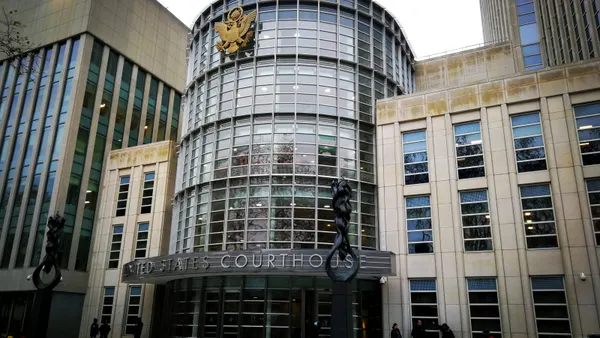
Plaintiffs in the case have asked U.S. District Judge Brian Cogan in Brooklyn, New York to approve a second disbursement of funds, according to their filing with the court. The settlement for the damages portion of the case was reached in 2018 and received final approval by a federal judge the following year, followed by appeals.
The settlement partially resolved a long-running antitrust case in which merchants alleged the two network giants charged excessive interchange fees when customers paid with a credit or debit card. The class of merchants includes any U.S. business that accepted Visa or Mastercard-branded cards between Jan. 1, 2004, and Jan. 25, 2019.
The next settlement distribution would be “at least $182 million” for about 84,000 claimants, if Cogan approves it, according to the plaintiffs’ motion. He approved the initial distribution in October 2025.
Plaintiffs sent claim forms to about 18.6 million merchants, with a February 2025 deadline for them to file a claim. The process has been marred periodically by fraudulent, incomplete or noncompliant claims, many of them solicited by third parties.
The sluggish pace of settlement payments has become frustrating for some merchants, with the first disbursement occurring about four months ago — one year after the claims deadline.
“If it took a full year to pay the easiest claims, how many years will it take to administer the more complex claims that were excluded from this initial payout?” Cascade Settlement Services, one of the claimants, asked in its Feb. 26 motion.
Cascade is a legal services firm that helps class-action members file claims and purchases claims in some cases. The company has acquired the claims of hundreds of merchants claiming hundreds of millions of dollars of interchange fees, according to a motion filed by its lawyer.
“About $1.5 billion sits idle in the settlement fund, with no published timeline for release,” the attorney for California-based Cascade contended in its motion.
Cascade asked the court to direct Epiq “to file regular, detailed, public monthly reports regarding the progress, any bottlenecks, and timeline of the claims administration process.”
Last week, Magistrate Joseph Marutollo denied Cascade’s motion after a hearing on the matter. But he directed the parties to discuss “periodic public reporting by Epiq” and to update him this week with any agreement.
Cascade’s attorney, Kassra Nassiri, did not respond to an email Tuesday seeking comment.
Alexandra “Xan” Bernay, an attorney for the plaintiffs with the law firm Robbins Geller Rudman & Dowd in San Diego, also did not respond to a message Tuesday seeking comment. Two Epiq executives, including Loree Kovach, the senior vice president overseeing the Visa-Mastercard claims process, did not respond to several messages seeking comment.
Under the claims process, merchants are to receive settlement “payments equal to their pro rata share of the settlement fund,” based on Visa interchange fees they paid relative to the fees paid by all of the merchants, according to a May 27 filing by the class attorneys, supporting their motion for a second distribution.
Roughly 96,000 merchants were excluded from the first round of payment because of “variances between the merchant names in the data and the claims submitted,” plaintiffs’ counsel wrote.
Epiq has since audited and cleared about 75,000 merchants from that group and “there are no other impediments to providing a partial distribution” to them, the attorneys wrote. Their claims are valued at about $125 million.
Another group of 8,400 merchants – initially excluded due to questions about their tax identification numbers – has been cleared for payments worth about $56.2 million, according to Epiq’s filing with the court.
Atop the claims Epiq has resolved, more than 500,000 merchant claims remain in “a multi-step dispute process” over the merchants’ fee payments, according to Cascade’s motion. Class members and the court have no insight into the internal Epiq backlog, the firm contended.
The settlement fund administrators have reserved about $3.35 billion related to the outcome of two separate lawsuits about merchants within the class membership.
One of the cases involves a California salon owner and other class members who paid interchange fees via Block’s Square payment processing product, and whether they had paid the interchange or if Block had. Those merchants argued that Block merely passed the cost along to them.
The other was brought by gasoline retailers that sued the networks under state antitrust laws and argued they were not part of the federal class because their gasoline suppliers paid the interchange fees.
The networks challenged both positions, winning at the district court level and, last month, at the 2nd Circuit U.S. Court of Appeals. The plaintiffs in both cases are seeking a full review by the appeals court and may ask the Supreme Court to take their cases, according to the settlement plaintiffs’ filing.
“While the ultimate resolution of the two appeals are pending and funds are held back to account for the final outcome, it is in the best interests of the class to make a proposed second, partial distribution to the subset of Claimants whose payment eligibility is now certain,” the plaintiffs told Cogan in their filing.
Separately, Cogan on Monday reappointed a special master to help resolve disputes and other conflicts with claims for a second, two-year term. The court reappointed James Orenstein, a retired magistrate judge, as the special master to continue a role he began in September 2024.