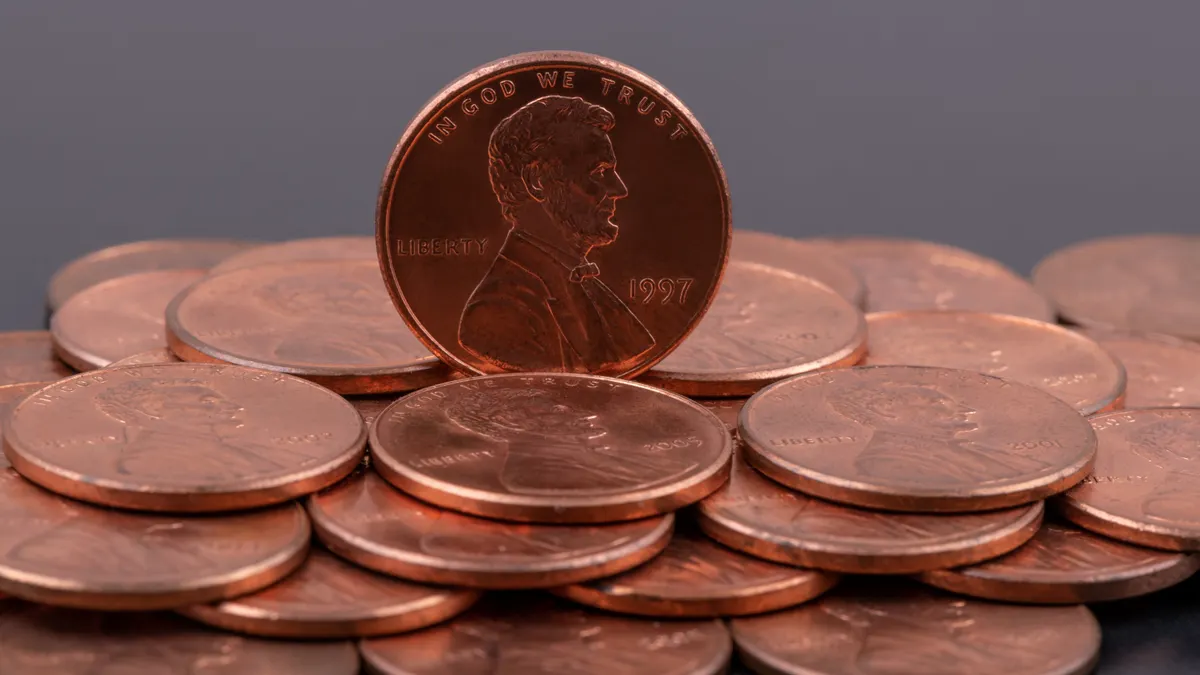
Businesses would gain new guidelines for rounding transactions if the government gradually phases out the U.S. penny under legislation Congress is considering.
The Common Cents Act, which passed the House of Representatives on Tuesday, enacts formal guidelines for businesses to round tabs to the nearest 5 cents as the U.S. gradually retires the penny.
A Senate version of the bill remains in the Committee on Banking, Housing and Urban Affairs, according to Congress’ legislative website.
The bills also officially end production of the penny, although the U.S. Mint manufactured its final batch of pennies in November. The bills’ sponsors say that penny production wastes about $85 million of taxpayer money each year because each 1 cent coin costs 3.69 cents to make.
About 15 states have passed laws to govern cash rounding, causing a “confusing” patchwork of rules, a coalition of 16 business trade associations said Monday in a letter to House leaders.
“We need a clear standard from Congress allowing businesses to round cash transaction amounts and a safe harbor from liability in doing so fairly,” wrote the groups, which included the National Restaurant Association and the National Association of Convenience Stores.
The American Bankers Association and America’s Credit Unions also supported the bill in separate letters to House leaders.
The bipartisan legislation dates to last year, when bills were introduced in both houses by a group of lawmakers that included Rep. Lisa McClain, a Michigan Republican; California Democratic Rep. Robert Garcia; Sen. Cynthia Lummis, a Wyoming Republican; and Sen. Kirsten Gillibrand, a New York Democrat.
“Republicans and Democrats don’t agree on much in this town but we do agree on this: We should not be wasting $85 million a year to keep minting pennies,” McClain said Tuesday on the House floor before the vote.
About 114 billion pennies circulate, according to the Treasury, although the production halt has led to shortages. Some businesses impose their own rounding on tabs, or ask customers to pay with exact change.
The National Retail Federation has made the rounding legislation one of its most important policy priorities for 2026, given what it calls consumers’ confusion over retailers’ inability to make exact change and the potential for “unnecessary legal risk.”
The Retail Industry Leaders Association urged the Senate in a Tuesday press release to pass its companion bill to “resolve an issue that has been negatively impacting millions of businesses nationwide.”
The penny’s end “created serious operational challenges and legal uncertainty for retailers of all sizes,” Stephanie Johnson, head of government affairs for the National Grocers Association, said in a Tuesday press release. “The Common Cents Act provides the clarity businesses need to continue conducting cash transactions fairly, consistently, and without disruption for consumers.”
Under the legislation, transactions that end with 1, 2, 6 or 7 cents would be rounded down to the nearest amount divisible by five; those ending with 3, 4, 8 or 9 cents in the sum are rounded up. Electronic payments are excluded.
The Treasury Department said rounding should not affect overall prices that consumers pay, as transaction totals will move both higher and lower. However, the Federal Reserve Bank of Richmond estimated in a briefing paper last year that this “rounding tax” would cost Americans about $6 million annually.
In phasing out the penny, the Treasury Department said last year that penny fabrication isn’t “fiscally responsible or necessary” for commerce, citing the “increasing number of non-cash transactions and the very low purchasing power of a single penny.”
The department estimated $56 million in savings from stopping the production of pennies, but noted that the coin would continue circulating “for as long as possible.”
In February 2025, President Donald Trump directed the U.S. Treasury to stop making pennies, citing the cost inefficiency. The penny dates to 1793, with the latest version bearing President Abraham Lincoln in circulation since 1909, according to the U.S. Mint.
Separately, Treasury Secretary Scott Bessent said Wednesday on his X social media account that the U.S. Mint will start striking a $1 dollar gold coin, to circulate, with Trump’s image. The administration touts the coin as a commemorative collectible given that federal law requires U.S. currency to bear only the portrait of “a deceased individual.”