The Federal Reserve’s instant payments system has been connecting to more financial institutions and reaching more accounts, resulting in an 85% jump in the number of settled payments for the second quarter of this year, compared to the first quarter.
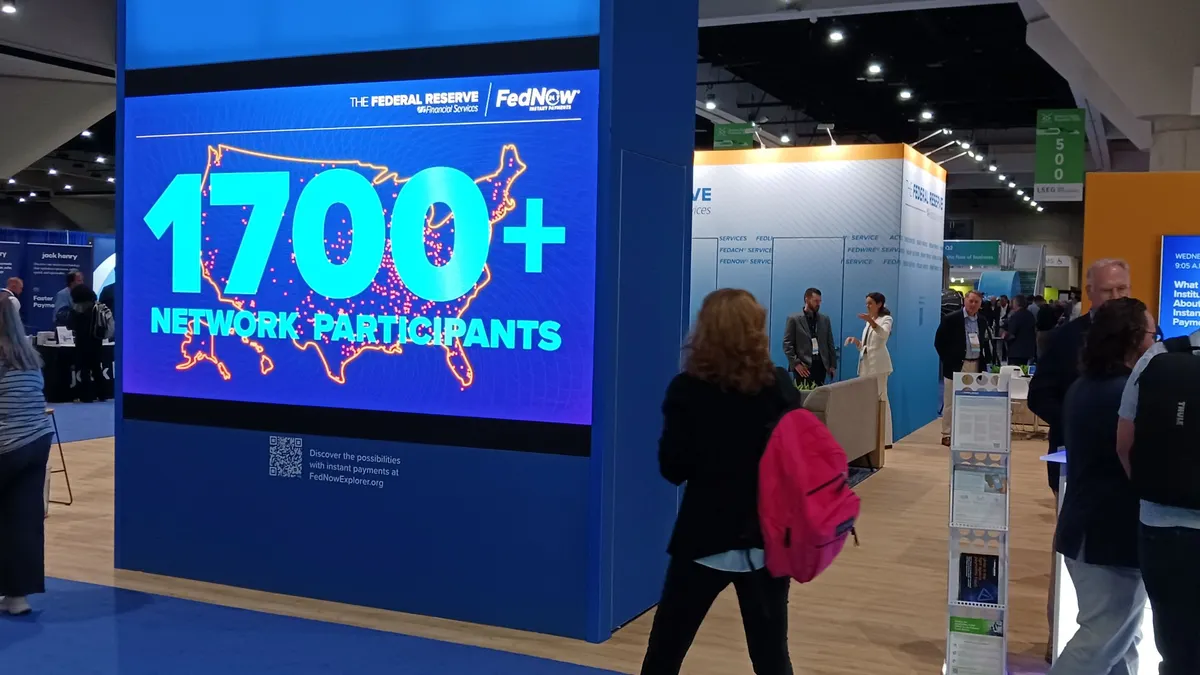
A Fed update last week said 1,800 banks and credit unions have now adopted the FedNow service since it launched in mid 2023, including seven of the top ten U.S. banks. That means about half of U.S. savings and checking accounts have access, according to June 30 statements from Chief FedNow Executive Nick Stanescu.
The Fed has been wooing financial institutions to the system for three years, seeking to fill out a more extensive web of banks and credit unions that use the system to settle payments within seconds. Use cases for the real-time system include insurance payouts, real estate transactions, car purchases and earned wage access tools, among other purposes, according to the July 7 Fed update.
“This underscores the fact that businesses and consumers are demanding instant payments and financial institutions are responding to that demand,” said Reed Luhtanen, who leads the Faster Payments Council, a trade group focused on speeding up payments. “I anticipate the rate of adoption will continue to accelerate,” he added by email when asked to comment on the latest FedNow update.
U.S. plays catch-up on trend
The U.S. has lagged some countries, including India and Brazil, in creating faster payment options, ranking 11th in the world in terms of global real-time payments adoption as of 2023, according to a 2024 report from digital payments software company ACI Worldwide.
ACI stopped producing that report last year, but the FedNow update shows the U.S. isn’t the laggard it used to be, said Bridget Hall, ACI’s leader for real-time payments in the Americas.
“We used to talk about the U.S. being behind on real-time payments, and I think we can solidly say that we're not behind anymore,” Hall said in an interview last week. “We have established instant payment schemes in the U.S.”
The FedNow system was launched partly to reach smaller community banks and credit unions that weren’t necessarily keen on the idea of joining a private sector real-time payments system, the RTP network, created in 2017 by their large bank competitors.
For its part, The Clearing House reported that RTP processed 142 million transactions worth $576 billion in the second quarter, with about 1,280 participants using that private system as of June 2026, according to an update for the period. That high-speed system reaches about 70% of accounts, or 90% through intermediaries, TCH says.
Despite real-time progress in the U.S., only about a fifth of the 9,000 U.S. financial institutions have signed up for FedNow, so the central bank has a ways to go to reach its prediction of attracting 7,000 to 8,000 of the U.S. financial institutions.
In addition, many of those institutions have signed up only to receive the instant payments, as opposed to signing up for the riskier feature of sending of the non-reversal payments.
Pushing real-time payments with use cases
Persuading financial institutions to have that two-way path for real-time payments is key for spurring more ubiquitous use, but luring them to add the send feature remains a challenge.
“There's a lot of focus that needs to be done around connecting participants as send [participants] so that they are able to not only receive in those connected accounts, but also the ability to send from them as well,” Hall said.
Neither FedNow nor RTP report the number of senders that are on their systems, Hall said. A spokesperson for TCH said RTP currently has 156 financial instutions authorized to send payments. That’s equal to about 12%.
A Fed spokesperson declined to comment on the number of FedNow participants that can send.
The build-out of request-for-pay features could also prompt more use of the system. “It is somewhat common knowledge within the industry that the use of requests for pay still is quite low,” Hall said.
Only financial institutions can connect to the FedNow system, with the expectation that banks and credit unions extend the option to companies for commercial and consumer use cases.
Federal agency support for FedNow
For FedNow, early adoption by the Treasury Department was designed to kick-start use of the system and prompt other users to take to the offering. The Federal Emergency Management Agency last year also started delivering disaster relief through FedNow.
In another Fed move that holds potential for expanding use cases, the central bank in April proposed changing its FedNow regulations to let financial institutions that participate in the instant payments system tap intermediaries for fund transfers.
The central bank suggested that the system change, specifically to Regulation J, might spur banks to work with intermediaries, like international banks, to send cross-border payments.
“With the Fed looking at the amendment to Reg J to open up the intermediary piece of FedNow to match Fedwire – so that we can start looking at cross-border instant payments – that's where we've seen some additional conversations as well on what use cases will be coming next,” Hall said.
For now, the Fed hasn’t said much more about that new cross-border possibility as it sifts through comments on the proposal that were due last month.
Given how big the federal government is, some industry watchers wonder why there have not been more federal agencies finding a use for real-time payments.
For instance, the Social Security Administration, led by former Fiserv CEO Frank Bisignano, might be a candidate for using the service, suggested Jim Angel, a Georgetown University professor who previously served on the Fed’s Faster Payments Task Force that provided early guidance for FedNow.
“If the government made it clear [it was] going to pay the Social Security benefits faster to FedNow recipients than to ACH recipients, then the laggard banks would be under strong commercial pressure from their customers to sign up for FedNow,” Angel said by email.
The Fed spokesperson declined to comment on that possibility.