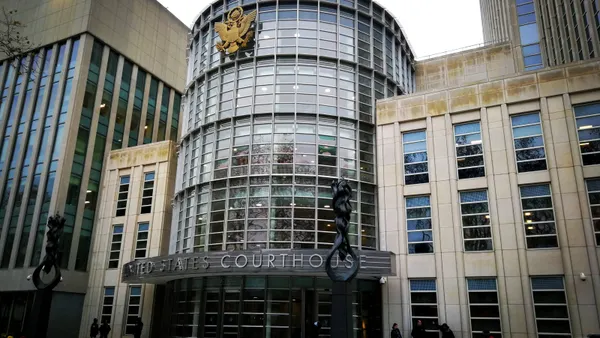
The Federal Reserve has improperly determined rules for setting a fee cap on debit card transactions, a federal appeals court ruled Monday in vacating the central bank’s current 21-cent fee limit.
The decision by a three-judge panel of the Eighth Circuit U.S. Court of Appeals – which backed a lower court ruling from last year – represented a victory for merchants that have battled payment card swipe fees for years.
Plaintiffs alleged that the Federal Reserve System Board of Governors should have set a debit card interchange standard that considers only an issuer’s marginal costs for a transaction, not the fixed expenses that come with its overall business. Any costs “not specific to a particular electronic debit transaction” shouldn’t be used by the Fed to set the debit fee cap, the court found in reading the statute.
That type of cost distinction within the Fed’s Regulation II rules is what Congress intended in 2010 when it added the Durbin Amendment to the Dodd-Frank Wall Street Reform and Consumer Protection Act, the St. Louis-based appeals court said.
The Fed’s current debit card fee structure includes far more than the marginal cost for each debit transaction, and disregards Congress’ intent when it enacted the amendment, the appeals court panel wrote in its ruling.
The Fed’s rate cap included banks’ “fixed costs related to authorization, clearance, and settlement,” along with network processing fees, costs for fraud prevention and for losses due to fraud, the appeals court said.
“It does not take much detective work to figure out that the Federal Reserve ‘shall . . . consider’ marginal costs in setting debit-card interchange fees, but not fixed costs,” the judges wrote. “No matter how much some banks and payment networks disagree with approaching the problem this way, the Federal Reserve does not get to revise Congress’s work.”
“Make no mistake, debit-card interchange fees do not have to exactly match marginal cost,” the court added. “The word ‘proportional,’ after all, does not require perfection. The Federal Reserve is free to use a proxy, perhaps even average variable cost, if it bears a ‘reasonable’ relationship to the marginal costs incurred by cardholder banks in processing debit-card transactions.”
As part of Regulation II, the Fed capped debit card swipe fees in 2011 at 21 cents, plus 0.05% of the value of the debit transaction, in addition to allowing a one-cent fraud-prevention add-on.
The cap is subject to revision every two years, and applies only to banks and financial institutions that have $10 billion or more in deposits. The Fed proposed in October 2023 to change the cap for the first time, suggesting the base debit fee rate be lowered by about 30% to 14.4 cents. The Fed has not moved forward since then.
A Fed spokesperson said the agency had no comment on the ruling or the status of its 2023 fee proposal.
The Fed “must sort the costs into those that are transaction-specific and those that are not,” the appeals panel wrote. “Not just pick a number and hope it is close enough for government work.”
The lawsuit dates to April 2021, when Corner Post, a truck stop and convenience store in Watford City, North Dakota, filed a lawsuit against the Fed seeking to lower its debit card transaction costs.
U.S. District Judge Daniel Traynor in North Dakota struck down the Fed board’s fee regulations in August 2025, leading to the appeal. Traynor has since joined the Eighth Circuit court after the Senate confirmed him in July. He was not on the three-judge panel that ruled on the Fed’s appeal.
The Merchants Payments Coalition hailed the ruling in a press release as a win for both merchants and consumers.
“Two courts have now agreed that the current rate lets banks collect billions of dollars a year more from stores and their customers than the law ever meant for them to have — far more than it takes to cover their costs and earn a healthy profit,” Doug Kantor, who is general counsel for the National Association of Convenience Stores, said in the press release.
Kantor, who also sits on the coalition’s executive committee, called for the Fed to replace its debit-fee rule “with one that complies with the law and takes some of the upward pressure off the prices shoppers pay every day.” NACS was among numerous merchant and banking groups that filed amicus briefs with the appeals court.
Bank and payment groups, including the American Bankers Association, America’s Credit Unions and the Electronic Payments Coalition, said in a joint statment Monday they were “deeply disappointed” by the 8th Circuit’s decision.
“For more than a decade, corporate megastores have pocketed billions from the Durbin Amendment while ignoring promises to lower prices for consumers,” said the statement from six groups. “Now, they want to pay even less for the very payment system they rely on every day, leaving banks, credit unions and consumers to shoulder the costs.”
The trade groups also pointed to a second case over debit card fees pending in the Sixth Circuit, Linney’s Pizza vs. Federal Reserve, in which a federal court in the Eastern District of Kentucky last year found in favor of the Fed’s rule.
“It’s important to remember that this decision is not the last word on these issues,” the bank groups said in their statement.