Dive Brief:
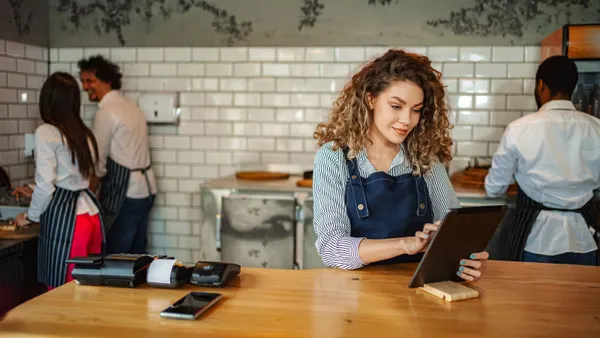
- Block has added 30,000 additional Square restaurant merchants to its local commerce network, called Neighborhoods, as it seeks to boost sales, the company said Tuesday in a press release. The program offers menus from Square merchants to Cash App mobile users for food and drink orders. Block declined to say how many merchants total are enrolled in the local network or its payment volume.
- Cash App users who frequent Neighborhoods-listed merchants account for about 10% of a seller’s gross payment volume after about nine months, on average, Block said in the press release.
- “The big thing that we’re looking to support is what are the things that happen on your daily rituals?” James Schonzeit, Square’s head of food and beverage, said Monday in an interview. “The places you might go to start your day, places you might take a family, and a lot of that comes down to the food and beverage businesses in your neighborhood.”
Dive Insight:
Block debuted the Neighborhoods program in October 2025 as a way to create a local network between its 59 million Cash App monthly users and about 4.5 million merchants that use Square. Customers pay for their orders through Cash App.
The Neighborhoods initiative represents a lower-cost loyalty program for many merchants, as Block offers Square sellers a 1% processing fee for orders from Cash App users, half of Square’s usual fee.
The program is a lower-cost sales channel and alternative to food-order behemoths like DoorDash, Grubhub and Uber Eats, part of Uber Technologies, Mizuho Securities analyst Dan Dolev said in an interview last month. It also gives local merchants a loyalty program with customers through the order discount and other promotions delivered via Cash App.
“We’re seeing the (Neighborhoods) numbers starting to inflect in a meaningful way,” Owen Jennings, Block’s head of business, said of the program on Block’s Aug. 5 quarterly earnings call. “We have a huge opportunity to drive deeper engagement and deeper monetization,” he said.
Block will “lean into investments to scale this differentiated network faster” in the latter half of 2026, Amrita Ahuja, Block’s chief financial officer and chief operating officer, said on the call. Ahuja did not specify how much Block would invest in its Neighborhoods expansion. A spokesperson for the company declined to comment, referring to the income report.
Food and beverage sellers represent the largest industry vertical by payment volume for Square, at about 35%, according to the company’s 2025 annual report.
The program encourages Cash App users to “follow” local merchants from whom they can order and earn up to 10% of an order total, as much as $10, in a currency called Local Cash. Users can apply these loyalty funds to future purchases from Square sellers. Block pays for the 10% discount for 12 months to entice merchants to participate in Neighborhoods.
The program also offers local businesses an opportunity to better align their marketing efforts and mobile order platforms to avoid having to use disparate systems, Schonzeit said.
“Sellers have been really excited about bringing together pretty disconnected systems,” he said.
Prior to its expansion of Neighborhoods, Block had to learn more about the locations of its Square restaurants and Cash App users, to ensure that the demographics of the two sides were aligned in each area, Schonzeit said.
In the future, the Neighborhoods program could help merchants identify potential new areas for business expansion, he said, given Square’s “good understanding of purchase behaviors across different parts of the country.”
Editor’s note: This story has been updated to include a comment about Block’s Neighborhoods investment.