Update: Feb. 25, 2026: Bloomberg News reported Tuesday that the fintech Stripe may be interested in buying PayPal, or some of its assets. A spokesperson for Stripe declined to comment.
--------------------------------------------------------------------------
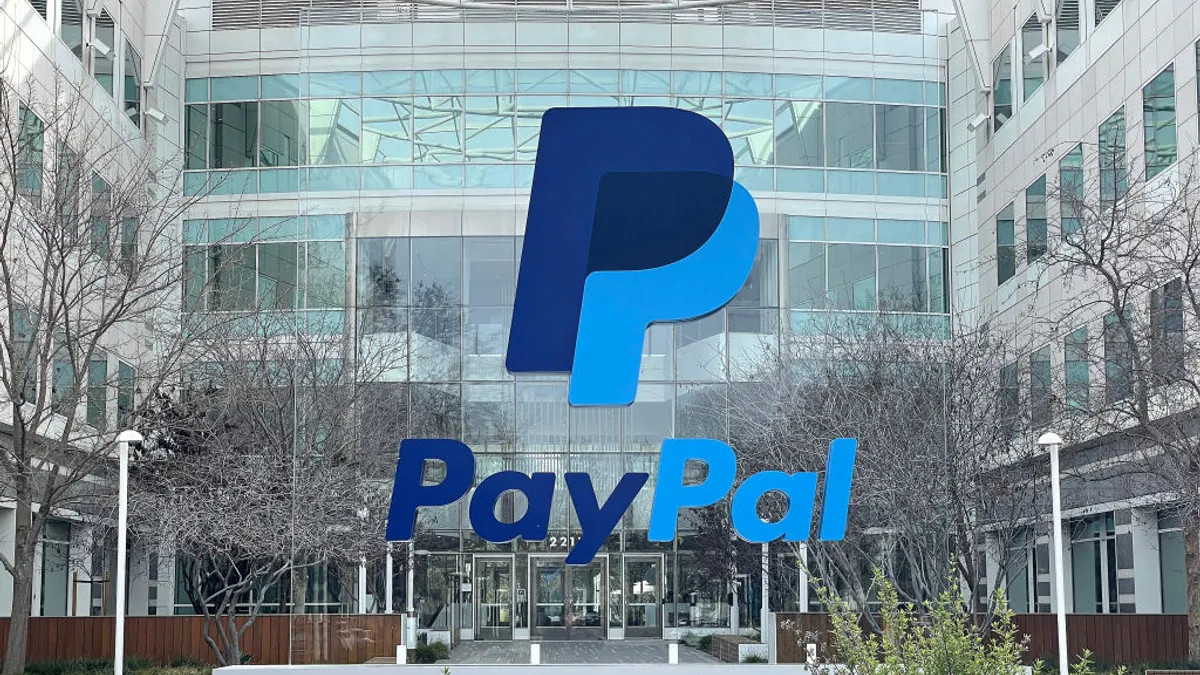
There aren’t many companies in the payments sphere that could digest a $40-billion market-cap company like PayPal Holdings, but there are a few possibilities.
The news media outlet Bloomberg News reported Monday that “one large rival” might be interested in buying PayPal. Still, the report noted that a transaction isn’t guaranteed, and the story didn’t give many hints as to who the suitor might be.
A PayPal spokesperson declined to comment on the news report, referring to it as speculation.
Nonetheless, PayPal finds itself suddenly on the salesblock after its value plunged in recent weeks following the company’s disappointing fourth-quarter financial report, showing unexpectedly slow growth. The stock has sunk 42% over the past year.
On the same day it released the dismal results, PayPal announced the exit of its CEO Alex Chriss, and the hiring of board chair, Enrique Lores, for that role, effective March 1.
Despite a large field of payments players, a process of deduction narrows the pack of would-be acquirers fairly quickly, with few having the financial wherewithal to pony up billions of dollars to buy the San Jose, California-based digital payments network company.
Most big payments processors, including Global Payments, Fidelity National Information Services and Fiserv, wouldn’t have the financial chops to buy the company, even if they weren’t already busy with their own recent acquisitions in the first two instances, and battling other troubles in the third case.
The Dutch processor Adyen has ambitious growth plans, but buying PayPal would be a huge undertaking for it, and isn’t likely, Morningstar analyst Brett Horn said in an interview.
Card giants Visa and Mastercard could ostensibly afford the purchase, but they’re unlikely to be interested in absorbing another network, analysts said. They “are big enough, but I don’t think it makes sense for them,” said David Koning, a Robert W. Baird analyst covering the area, in an emailed comment.
Likewise, Zelle, the digital network held by Early Warning Services, is owned by a group of banks that probably aren’t interested in such a transaction, said Horn, who focuses his research on payments and financial services companies.
Other young digital payments players that might take an interest in PayPal’s assets include Block, which owns the processor Square and the digital wallet Cash App, but its $32-billion-dollar market cap also makes it too puny to absorb PayPal. While digital payments upstart Stripe’s private stock sale this week valued the company at $159 billion, it seems more focused on an organic growth path.
The big tech payments player that comes to mind for Morningstar’s Horn as a plausible purchaser is Apple, which he believes has been outcompeting PayPal with its Apple Pay digital wallet, he said.
“That would be easy,” Horn said of Apple’s capacity to pick off PayPal with its nearly $4-trillion valuation. If a rival were to buy all of PayPal, it would have to be “one of the bigger tech companies.” Google is further afield as a possibility, given its other tech pursuits, he said.
When asked about tech titan Elon Musk’s recent interest in resurrecting his PayPal past by developing a digital wallet at his company X, Horn said it’s hard to know how seriously to take those plans, given all of Musk’s other interests. (The billionaire also owns car-maker Tesla and the space exploration company SpaceX, among other ventures.)
Indeed, Musk’s deputy spearheading the payments project at X, Linda Yaccarino, exited the company last year.
PayPal wouldn’t have to be sold as one business though. It may make more sense to sell it in pieces, especially given past CEOs’ failures to knit them together in synergistic ways.
Those three units are all well-known payments businesses: the pioneering legacy PayPal digital checkout business; the Braintree unit that services large corporate clients; and the peer-to-peer payments tool Venmo, tilted to a younger demographic.
The businesses prospered during the COVID-19 pandemic as consumers and companies turned to digital payment alternatives, pushing up PayPal’s market valuation, but growth lagged. “The market got way ahead of itself during Covid and then it came down to earth,” Horn said.
Despite its strengths, PayPal’s checkout services have failed to effectively fend off a slew of competitors; Braintree has struggled to push up prices and profits; and Venmo has languished as efforts to monetize its services have fallen flat.
Still, when considering the possibility of PayPal being sold off in pieces, the potential purchasers multiply, said Horn, suggesting there are too many to cite.
But maybe the most likely buyer isn’t a payments player after all.
That’s a “tough sell,” said Wells Fargo analyst Jason Kupferberg, who also specializes in coverage of payments and financial services. “We think private equity would make more sense than a strategic buyer,” he said in an interview.
He didn’t cite any particular names, but pointed to the Chicago private equity firm GTCR’s 2023 acquisition of Worldpay as an example of how a financial buyer might make sense. GTCR installed new leadership at Worldpay and accelerated growth, he noted.
Then, it sold the company to Global Payments last year, for a lucrative exit of the business.
Selling off Venmo might make sense, but Kupferberg expects investors will push PayPal to make “bolder” moves now to “maximize” the value of the company.
Chriss is the second PayPal CEO to grapple with growth plans, following the exit of Dan Schulman before him.
Ultimately, PayPal’s business is still profitable and unique in its extensive scale, with younger competitors unable to match its extensive two-sided marketplace, including consumer subscribers on one side and merchants on the other.
“They still have a decent future ahead of them,” Horn said of PayPal’s set of businesses. Maybe that future is just under new ownership.