As retailers seek point-of-sale systems to integrate various sales channels, a retail technology firm founded by Walmart technology alums has created a demonstration lab that allows merchants to test multiple POS vendors’ wares.
Kitestring Technical Services aims for its innovation laboratory to be a vendor-neutral testing and demonstration site for retailers to evaluate POS equipment in the market. The lab currently has seven software and 14 hardware vendors.
Point-of-sale equipment decisions are major, multi-year, multimillion dollar projects for retailers, carrying multiple risks across hardware and software choices, said Lindsay Schwab, Kitestring’s head of partnerships and growth. As a result, such decisions are generally made with extreme caution.
“We like the idea of being able to have retailers come into our office and be able to see, side by side, all of the different point-of-sale systems that they’re interested in,” she said last month in an interview from Kitestring’s lab in Bentonville, Arkansas.
Kitestring debuted the lab in January at the National Retail Federation’s annual Big Show conference in New York City.
Kitestring is a privately held, family-owned company, with about 140 employees, led by CEO Jared Smith who acquired the business from his father, Larry Smith. The company has evolved from point-of-sale work that many of the current management team performed for retail giant Walmart over the past 20 years, Schwab said.
Today, Walmart and its Sam’s Club wholesale operation account for only about 20% of Kitestring’s revenues, Schwab said. The diversified company now counts major grocers, department stores and a half dozen major convenience store chains as clients as well. Kitestring’s customers generally have annual sales above $300 million, she said.
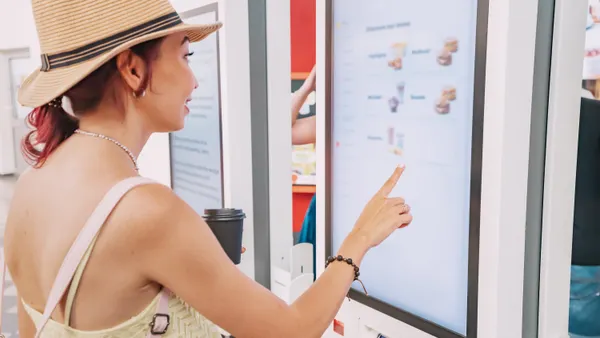
Many retailers want integrated solutions to handle sales in various points: Digital, in-store, kiosk, mobile and orders from third-party retail sites like DoorDash and Uber Eats, said Justin Clark, retail technology specialist at Kitestring.
“If you’re going out there on the market today, you’re looking for a modern architecture that can do the online, along with the in-store experience as well,” he said in an interview.
The POS market has become more “agnostic” in terms of mixing hardware and software solutions from various providers, as long as the systems are designed to run on the same operating system such as Android, Linux or Windows, Clark said.
One of Kitestring’s customers, Altaine, a digital commerce technology firm, has used the lab to show a prospective retail client how its software handles an order flow with actual hardware, Jo Gelb, Altaine’s co-founder and chief operating officer, said in the call with Schwab and Clark.
“Obviously, everyone can do an emulator demo and just show screens, but what I think is quite powerful is to be able to show the emulator alongside the physical bits of hardware,” she said. Altaine’s order platform is used by merchants that include BP, Pizza Hut and Subway.
When Altaine lands a prospective customer, it turns to the laboratory for product demonstrations “because we know that they actually are nearly as expert on our technology as we are, just because of the hands-on nature of putting it in a lab,” Gelb said.
Diebold Nixdorf, a major supplier of POS and ATM products based in North Canton, Ohio, has implemented its retail hardware and software solutions at the lab.
“Retailers can experience how their POS and omnichannel solutions perform in realistic store scenarios and figure out how seamless retail experiences and personalized interactions can look,” Ed McCabe, Diebold Nixdorf’s head of retail sales for North America, said in an emailed company statement.