The payments industry has been evolving at a dizzying pace in recent years, and that’s not expected to let up this year.
Industry change is likely to revolve around regulatory dynamics in 2026. On the federal front, regulators will assert new authority in creating a framework for stablecoins, following passage of the Genius Act last year. Conversely, states are expected to step up oversight of emerging payment plays, such as buy now, pay later and earned wage access.
The courts and the Federal Reserve may also play important roles this year in resetting the thinking on card interchange fees as they weigh in on pending issues.
“The regulatory perimeter has been pretty well defined for decades, and now you see these opportunities, these possibilities, for very different types of financial institutions to be almost on an equal footing with the banks and payments companies,” said David Sewell, a Freshfields attorney who heads the law firm’s U.S. financial services regulatory practice from Washington. “Where that all shakes out, I don't know, but I think 2026 will be very informative.”
Below, we explore how six key payments trends may unfold, influencing the ways in which companies innovate, adapt and grow in the revised regulatory environment.
Stablecoins come into their own
For years the payments industry has circled stablecoins as a way to potentially simplify and reduce the cost of moving money between two countries.
A number of hurdles stand in the way of their use, not the least of which is regulatory uncertainty on the part of financial institutions. But with a regulatory framework for digital assets now established as part of the Genius Act, the day when digital assets can be regularly used to make cross-border transactions is edging closer.
President Donald Trump signed the Genius Act into law in July, creating rules for stablecoin use. The law's most important practical impact might be giving financial institutions the confidence to understand the rules of trading digital assets, according to industry insiders.
"There's a regulatory structure around what a stablecoin is, and more acceptance in the banking community to be able to move and change stablecoins to fiat currency," said Penny Lee, CEO of the Financial Technology Association.
Cross-border payments require multiple entities on both sides of the border, making such transactions complex and expensive. Stablecoins could solve both of those problems because a sender can convert a fiat currency into stablecoins, and send assets to a recipient in another country.
Payment processor Fiserv announced it would issue a stablecoin last year after digital payments pioneer PayPal introduced one in 2023.
Large merchants seem particularly interested in using the digital assets, Fiserv's head of product for merchant services, Sanjay Saraf, said in a December interview. He declined to mention any names, but Walmart and Amazon are considering issuing their own stablecoins, The Wall Street Journal reported in June.
"They're still trying to figure out the exact use cases," Saraf said. "But there's definitely traction in this space."
Forrester analyst Lily Varon pointed to a lot of “hype” enveloping stablecoins during an interview last month. While she sees benefits to stablecoins in principle — including their ability to operate around the clock, with speed and affordability, plus their borderless and permissionless nature — she’s reluctant to overlook flaws.
There are “a lot of problems” with stablecoins, she said. They offer a bad user experience, with all the onboarding and offboarding from other systems; there is a lot of risk with how it can be managed in digital wallets; there's a lack of general trust, given “de-pegging” events where the value wasn’t as stable as might be expected, Varon noted.
Agentic commerce takes hold
In 2026, you might need to speak with your electronic agent about a new pair of shoes. Few commerce developments have roused the payments world as much as the rise of agentic commerce, the coming artificial intelligence-fueled world of bot shoppers.
Seemingly every payments giant, including Amazon, Visa, Google, PayPal Holdings and Stripe, weighed in last year with proposed protocols, processes or plans for AI-powered agentic commerce, which enables digital agents to make purchases on behalf of buyers.
Automated shopping tools will presumably boost sales for merchants, potentially increasing the volume of fees for payment card issuers and networks. Advocates also contend that agentic commerce can better personalize the retail experience and reduce transaction friction.
“Typically, in payments, it takes 10 to 15 years to have a global technology adopted, but the pace of this technology is something else, because [of the] level of investment,” Mastercard’s chief digital officer, Pablo Fourez, said in an interview last month.
One issue agentic commerce is likely to face is whether using a bot leads to a fee or a discount for the human at the end of the transaction, said Hal Lonas, chief technology officer at Trulioo, which offers identity verification services.
Another issue agentic commerce raises is with respect to which agents will be trusted. In the future, agents might have ratings the same as mobile apps or Uber drivers, he predicted.
“Instead of going to an app store, you might go to an agent store,” he said. “And if you saw an agent that had 10,000 five-star reviews, you'd say, ‘OK, that looks pretty good to me, I guess I trust it.’”
Beyond agents buying goods for humans, agentic commerce will require new machine-to-machine payments, said Bam Azizi, chief executive of Mesh, a San Francisco-based cryptocurrency payments startup. Agentic shopping bots will pay a “price per crawl,” for example, 0.5 cent to search a specific API one time, which will require these microtransactions, he forecast.
Stablecoins are the only mechanism to support a global system of these agentic microtransactions, he said in a December interview.
Personalization tailors payments
Online shoppers are inundated with personalized suggestions for future purchases when they peruse marketplaces like Amazon. Now, as artificial intelligence lurches forward in sophistication, online shoppers will begin to see suggested payment methods as well.
This means that payment companies such as buy now, pay later firms and credit card networks will need to jockey for position in those suggestions much the same way that merchants jockey for top spots in online search results.
AI agents and online marketplaces that shoppers may also see what payment methods consumers have used, and can now ask if they want to use that method again, or try a similar payment method.
Shoppers will see messages that say "you used this payment method last time, would you like to use it again?" said Tevia Segovia, a partner at the consulting firm Bain & Company who focuses on financial services.
Companies like Stripe and PayPal have created personalized checkouts for shoppers that can recommend payment methods. "We tie shopping behavior of a customer who uses PayPal back to an identity, and then we centralize our services for things that benefit them," said Jeff Pomeroy, PayPal's senior vice president of payments, services and platforms.
Someone who has used a short-term installment loan from a buy now, pay later company might be asked if they'd like to take out a slightly longer term loan from the same company if they consider buying a more expensive item, Segovia said. This sort of personalization has broad implications for the payments industry, Segovia said.
Consumers could use these developments to save money, Segovia said. "You could give guidelines (to an AI agent) around maximizing points on a certain credit card for using your rewards," she said.
Still, there are questions that payments companies haven't entirely answered yet. "We're going to have to figure out the payments piece of it," said Erin Jaeger, head of North America for the buy now, pay later company Klarna Group.
Interchange wars persist
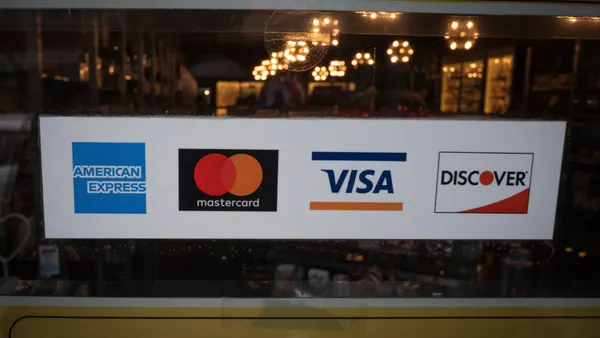
The war between card networks and merchants over card interchange fees is likely to heat up this year. That’s because three situations threaten to bring the issue to a head.
First, a November legal settlement between merchants and network heavyweights Visa and Mastercard regarding fees, and other issues, is pending and may be approved by a federal judge this year. With the court having asked for comment on the proposed pact, old arguments are bound to resurface. Many merchants, including mega retailer Walmart, have already opposed the settlement.
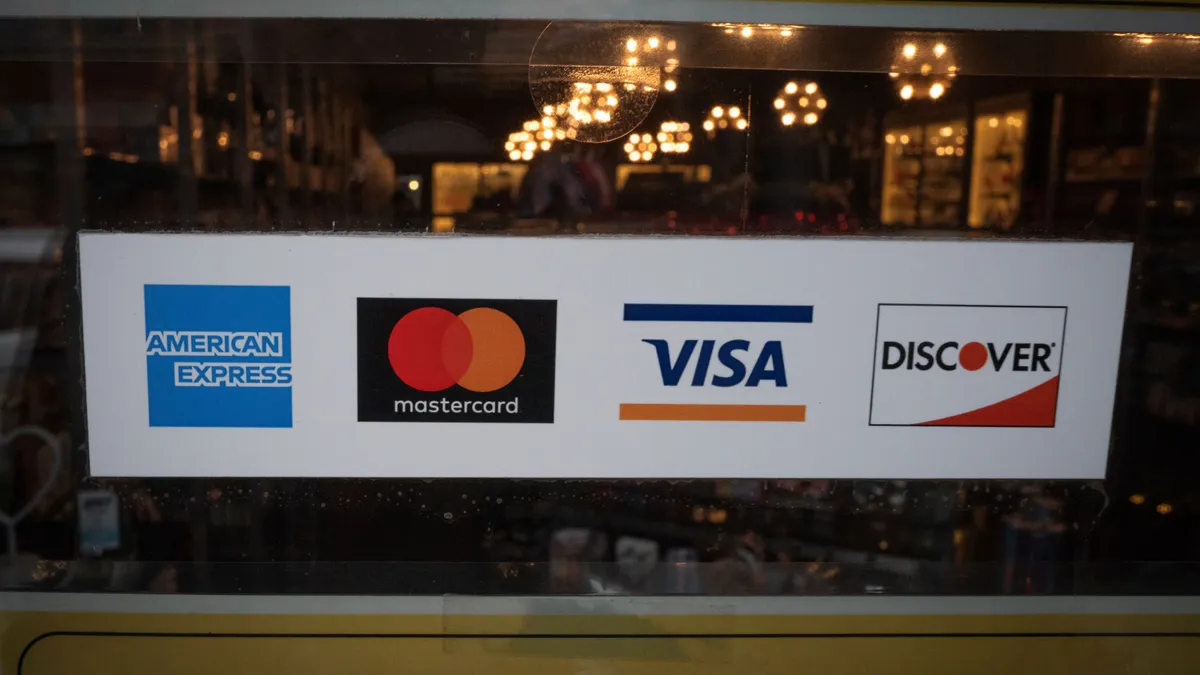
If the agreement receives court approval, interchange fee rates would be reduced by 10 basis points, on average, and capped for five years while giving merchants more flexibility to impose surcharges. All of that could roil interchange fee competition, including with American Express.
Second, the Justice Department is pressing ahead with a lawsuit against Visa over an alleged illegal monopoly in the debit card market. The company has denied those federal antitrust allegations, but any resolution of that case could also have a ripple effect on interchange fees across the industry.
Finally, the Federal Reserve has been in the hot seat for more than two years to determine how it will change its current cap on debit card interchange fees. The central bank declined to comment last month on when it may, or may not, move forward with a proposal to lower the cap.
Congress could revive legislation to put parameters on fees, but the proposed Credit Card Competition Act aimed at reducing fees by giving a boost to competitors, stalled in 2024.
Georgetown University McDonough School of Business Associate Professor Jim Angel, who has seen a lot of payments legislation float through Congress over the years, said it’s usually a crisis that forces change. That’s how the Dodd-Frank Wall Street Reform and Consumer Protection Act emerged, he recalled.
“You have a lot of these ideas that are popping up, and you have bills that go nowhere in Congress, and then you have some mistake or some crisis occurs,” Angel explained. That’s when politicians decide “we’ve got to fix this,” Angel said in an interview last month.
State regulation steps up
Throughout 2025, the Trump administration pursued a broad agenda of deregulation and cuts to the federal workforce.
As payments and financial technology companies enter 2026, it’s unclear whether one of the industry’s principal regulators – the Consumer Financial Protection Bureau – will continue to function, or to what degree.
Under the previous Biden administration, the bureau had sought to impose greater oversight of buy now, pay later lenders; companies offering earned wage access funds for employees; and makers of digital wallets and fintech apps.
The Trump administration reversed course on those efforts. States have quickly stepped into that regulatory gap on a variety of fronts. Last month, for example, seven state AGs sought information from a half dozen BNPL providers about their loans, customers and dispute-resolution practices.
Sewell, the Freshfields attorney, expects states will step up to fill the vacuum left by the CFPB.
“Some states will be very aggressive and some will not,” he said. “I think we can expect California, New York, probably Illinois, Massachusetts, and sometimes even Texas actually can be pretty aggressive on this stuff, stepping in to kind of play the role of the CFPB otherwise would have.”
How state oversight plays out will depend on the issue, Sewell said. They may put the brakes on earned wage access because it’s more controversial, whereas it will be tougher to restrict BNPL too much because of its consumer popularity, he predicted.
Kristen Larson, an attorney with Winthrop & Weinstine in Minneapolis, said state oversight is likely to expand.
The Trump administration moved quickly to target the agency for closure under Acting Director Russell Vought. In seeking to shutter the CFPB, the administration said the bureau cannot “lawfully” request money from the Federal Reserve.
“It’s likely the CFPB still continues to exist,” said Larson, who advises financial services companies. “Whether [the agency exists] at the same capacity as [it has] under prior administrations, I think that’s probably not the case.”
Attorneys general had filed 50 lawsuits challenging Trump administration actions, as of September, according to the Progressive State Leaders Committee, a policy group affiliated with the Democratic Attorneys General Association. In December, the PSLC said it had hired Rohit Chopra, the former CFPB director, as a senior advisor.
During the first Trump administration, state AGs filed about 150 multistate complaints and “they are looking forward to a similarly strong track record for Trump 2.0,” the committee said in September.
The CFPB’s dramatic shrinkage creates uncertainty for some companies, Larson said.
Congress transferred multiple regulations from the Federal Reserve system to the CFPB in 2010 when it created the bureau. That leaves the fate of those rules and their oversight unclear as the bureau recedes under Trump, potentially pushing regulations back to their former oversight entity.
That will keep attorneys being conservative in their counsel. “Even if they say, ‘we’re not going to prioritize enforcement of this,’ we're always going to tell you you should comply with laws and regulations,” Larson said.
To be sure, the federal government will increase clarity in the realm of stablecoins, with the Treasury Department and the Office of the Comptroller of the Currency expected to set new rules under the Genius Act. Meanwhile, stablecoin issuers are likely to shift toward that federal framework, moving beyond their operation under certain state laws, including those in New York, Wyoming and California, Sewell said.
“What I think we're going to see is a greater number of more established financial institutions, whether they're banks or nonbank payment companies, getting into this game,” he predicted.
Fraud keeps coming
As the payments realm keeps expanding, fraud threatens to keep growing too. Payments executives, government officials and industry association representatives have wrung their hands in recent years over rising payments fraud, from check theft to imposter scams to synthetic identity schemes. Despite some advances that could help, like the shift to ISO 20022, the trouble is likely to persist in 2026.
“Obstacles include privacy concerns; unclear standards about the information organizations can share without fear of liability; and a lack of resources, especially among smaller financial institutions,” the Chicago Federal Reserve said online in summing up discussion on the topic at its payments symposium in October.
It’s a mushrooming problem for companies and consumers. About three-quarters of respondents to an Association for Financial Professionals survey last year said their companies had been the targets of actual or attempted fraud. Being able to move cash instantly, with expanding real-time systems, increases risk, the group said. The impact can trickle over to vendors, customers and partners. Digital assets, such as cryptocurrencies, have also played a role in increasing payments fraud.
In its report on fraud last month, the Federal Trade Commission pointed to older adults as frequent victims for bank transfer, card and crypto frauds. Still, young consumers are also being taken in by fake job offers, said David Tyree, the director of financial crimes and investigations at the consultant Valid8 Financial.
Combatting the fraudsters will remain a challenge this year, with the payments community groping for additional defenses. It will take the public and private sectors working together to address all of these “complex problems” that “require complex solutions,” Tyree said in an interview last month.