Dive Brief:
- The draft of a bipartisan bill to provide a national regulatory framework for the earned wage access industry was circulated this week for commentary in the House of Representatives. The pending legislation is a variation on a Republican bill previously offered that has won a Democrat’s support.
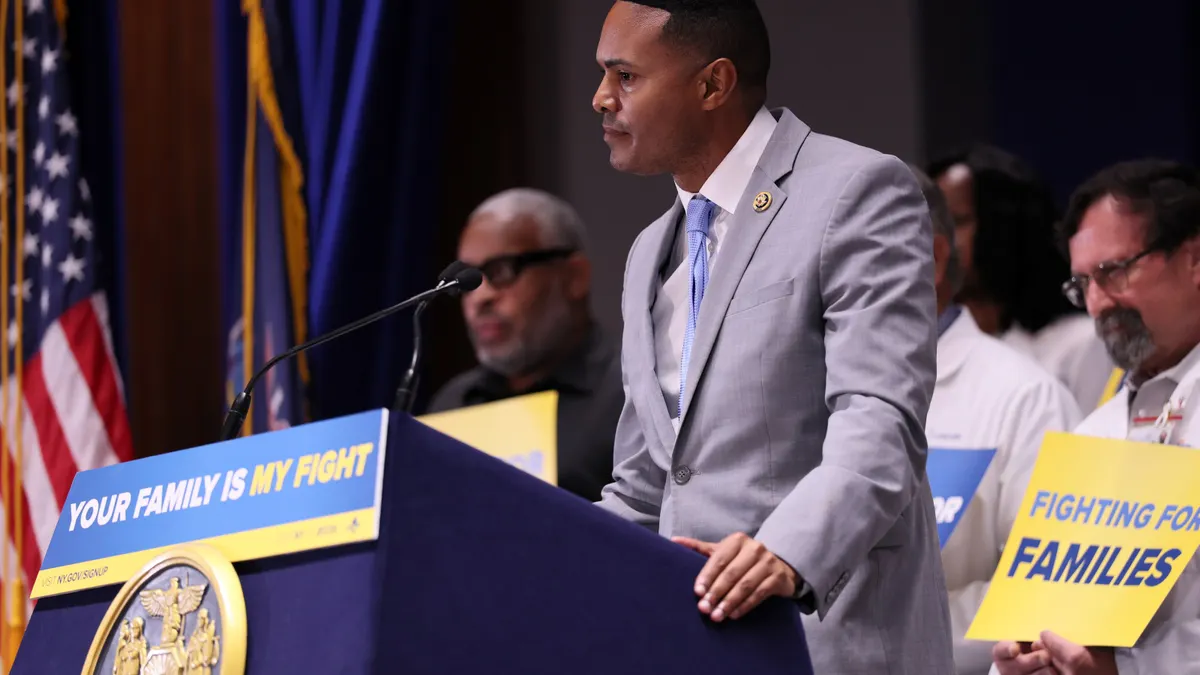
- Rep. Bryan Steil, a Wisconsin Republican, submitted the “Earned Wage Access Consumer Protection Act’’ Monday as draft legislation, with Rep. Ritchie Torres, a Democrat from New York City, announcing Tuesday at a House hearing that he’ll co-sponsor the bill. Steil’s prior EWA bill had no Democratic sponsors.
- The bill would require multiple disclosures about any fees and regarding whether a provider solicits “tips” as part of EWA transactions. It also preempts state laws that create “licensing, registration, qualification, or conduct requirements” for EWA providers, and requires a no-fee option if a firm assesses fees on some of its services.
Dive Insight
Earned wage access services allow workers to tap their earned wages before scheduled paydays. Supporters of the industry contend they are a cost-effective alternative to usurious payday loans.
“The notion that you must wait two weeks or even a month before accessing your own earnings should be seen as a scandal,” Torres said Tuesday at a House subcommittee hearing on fintech regulation that focused on EWA and buy now, pay later firms. “It should be seen as an anachronism in a world as technologically advanced as our own.”
The American Fintech Council and Financial Technology Association, trade groups that represent EWA providers, expressed their support this week for the legislation. The proposed bill would help EWA firms avoid a patchwork of laws in about a dozen states.
No companion bill has been announced in the Senate. The AFC said it has been working with members of the Senate Banking Committee “to improve their understanding of EWA services and introduce an EWA bill,” Ian P. Moloney, the American Fintech Council’s chief policy officer, said Wednesday in an email.
EWA providers make money by charging workers fees, or by receiving interchange fees from merchants if the workers’ funds are placed on and spent via a debit card. Some of the services are offered through employers, while others are marketed directly to consumers who may allow a provider to debit their bank accounts.
As it has grown, the industry has faced increasing scrutiny from regulators and state lawmakers, along with criticism from consumer advocates who argue that many workers become trapped in cycles of accessing their income to cover prior EWA activity.
The National Consumer Law Center released a critical report Monday on the industry detailing what it called “unfair, deceptive and abusive” practices by EWA providers.
“Earned wage payday lenders have engaged in many practices that deceive borrowers, trick them into incurring excess fees, and make it difficult to escape an escalating cycle of indebtedness,” the NCLC said in a summary of the report.
Last month, the Consumer Financial Protection Bureau rescinded a 2024 proposed rule that would have classified most EWA payments as loans, and subjected them to the U.S. Truth in Lending Act. In its advisory opinion, the CFPB drew a distinction between “employer-partnered” EWA programs and those that provide payments directly to employees.
In April, the New York attorney general sued two EWA providers, DailyPay and MoneyLion, over what that office called “expensive payday loans.” Private plaintiffs have also targeted EWA providers with lawsuits in federal courts.
The revised bill carries additional disclosure requirements on consumer fees and other EWA product attributes that weren’t in Steil’s 2024 bill, Benny Stanislawski, a spokesperson for Torres, said Wednesday in a telephone call.
Democrats have been engaging with the legislation because EWA products have “amassed millions of users in the past year,” Stanislawski said. “The affordability crisis is increasing and getting worse,” he said.
Torres’ district – which covers a large area of New York’s Bronx borough – is one of the lowest income areas of America and many constituents use EWA services, Stanislawski said.
The Financial Technology Association, which represents EWA firms including EarnIn and MoneyLion, said in a Tuesday press release that tens of millions of Americans use EWA to manage expenses and that “this critical legislation would protect workers’ access to their already earned wages.”
“Getting paid once or twice a month doesn’t work for most Americans, which is why fintech products like EWA are such a lifeline for workers facing affordability challenges,” FTA CEO Penny Lee said in the release.
The “consumer protection framework” reinforces the concept that EWA products are not loans and recognizes “the core principles of responsible EWA products and avoids forcing them into outdated lending laws that simply don’t fit,” Moloney said Monday in a statement about the bill.
The council represents EWA providers including New York-based DailyPay and Dave, a fintech based in Los Angeles.
Changes from the prior version of the bill include “a more robust subsection on non-discrimination” and “a more robust definition of what constitutes a ‘tip’ within EWA services,” Moloney said Wednesday in an email.
The role of such tips and donations for EWA providers has raised concerns among consumer advocates, who argue that they’re unwarranted and are often accompanied by excessive fees.
EWA firms often make multiple requests for tips and have user interfaces with multiple steps to avoid tipping, according to the NCLC report. Some providers have also “implied threats of consequences for borrowers who do not tip,” the report said.
Earlier this month, the AFC called out national EWA legislation as one of its top legislative priorities for 2026. “Clear policy in this area is critical to preventing misclassification that could eliminate safe options and push consumers toward high-cost alternatives,” the trade group said in a Jan. 8 statement.
“We prefer regulatory clarity from the federal government, as opposed to a state patchwork regulatory structure,” AFC Chief Executive Phil Goldfeder said in an August 2025 interview.