Dive Brief:
- Two earned wage access providers, DailyPay and MoneyLion, asked New York state courts Friday to dismiss complaints filed against them last year by the New York Attorney General’s office. The AG alleged that both firms make illegal loans that constitute abusive lending and violate New York’s usury laws.
- Both motions to dismiss, filed in the separate cases at the New York State Supreme Court, stressed that the services – offering employees early access to their wages – are not loans and therefore can’t be considered usurious. Both companies cited a December advisory opinion from the Consumer Financial Protection Bureau that many EWA products aren’t loans.
- If DailyPay’s motion isn’t granted, it asked the court to convert the “special proceeding” – an expedited lawsuit under state law by which the AG’s office filed its DailyPay complaint – to a plenary action. That change would afford the company discovery rights and a jury trial.
Dive Insight:
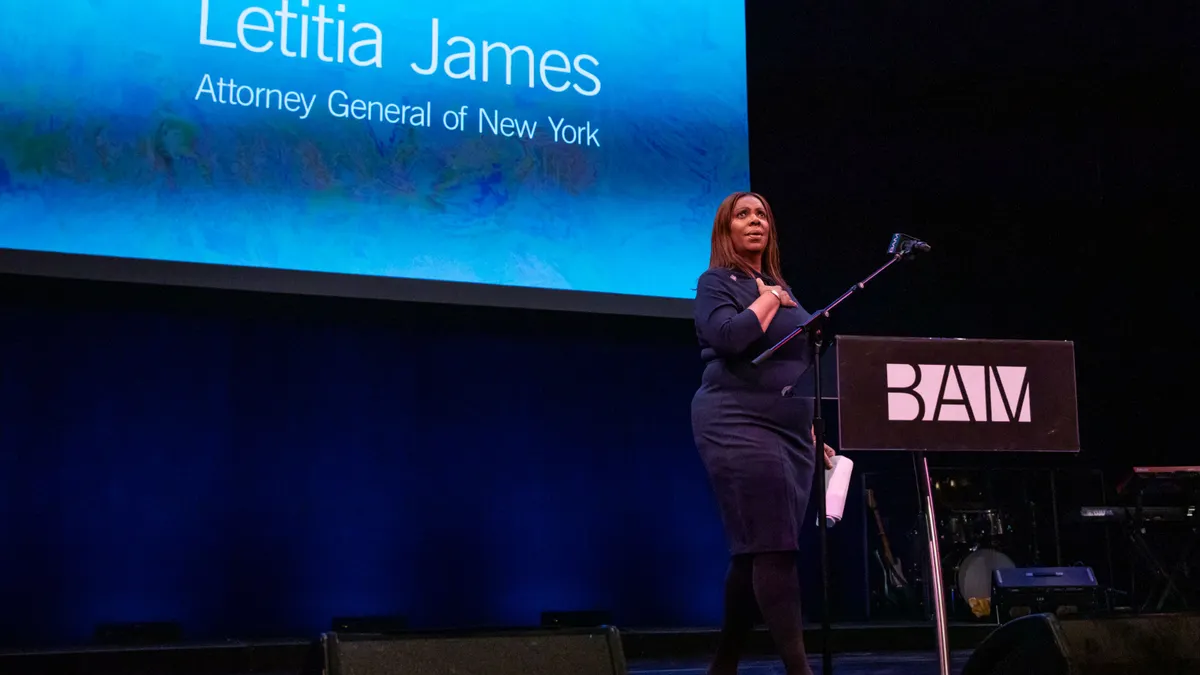
Lawyers for MoneyLion argued the lawsuit brought by the office of New York AG Letitia James is out of step with the federal government approach. “At bottom, (the Attorney General) asks this Court to rewrite existing lending laws to regulate a new service that is not a loan,” MoneyLion said.
EWA providers, also known as on-demand pay services, have proliferated in recent years to let workers, mainly hourly employees, tap their earned pay before a scheduled payday.
Each of the cases is being handled by a different state judge after both companies unsuccessfully sought last year to move the complaints to federal court.
The AG’s complaints also allege that DailyPay and MoneyLion, both based in New York City, assessed fees that equate to “outrageous annual interest rates in the triple digits.”
DailyPay, for example, charges a fee of $3.49 to $3.99 per transaction for faster delivery of funds. A no-cost option usually involves ACH bank delivery the following business day. Likewise, MoneyLion says it has no costs for a standard wage advance and charges fees only for “instant” cash delivery. It requests an optional tip from customers, “as with many other services,” MoneyLion said in its motion.
“Many states and the Consumer Financial Protection Bureau have confirmed that such services are neither loans nor credit,” DailyPay wrote Friday in its motion to dismiss the AG’s complaint.
At least a dozen states have passed laws to regulate providers without considering the advances to be loans, including California, MoneyLion said in its motion. “Although a few states have labeled these transactions as ‘loans,’ those states have nevertheless adopted tailored regulations with requirements that account for EWA’s unique nature,” the company wrote.
DailyPay also contested the AG’s claim of abusive lending, contending that EWA products cause workers to become dependent.
“When workers have addressed short-term financial issues, they often reduce, if not stop altogether, using on-demand pay,” DailyPay wrote in the motion. Only 3,012 New York DailyPay users made twice-per-week expedited pay transfers each month for all of 2024, compared to 35,886 who accessed twice-weekly advances for only a single month that year, the company said.
“These data reflect that DailyPay’s (on-demand pay) empowers workers to make financial decisions tailored to their needs,” DailyPay wrote. “That is financial freedom, not dependency.”
Because its paycheck-advance service doesn’t constitute a loan, there’s no potential for usury, DailyPay argued in its motion.