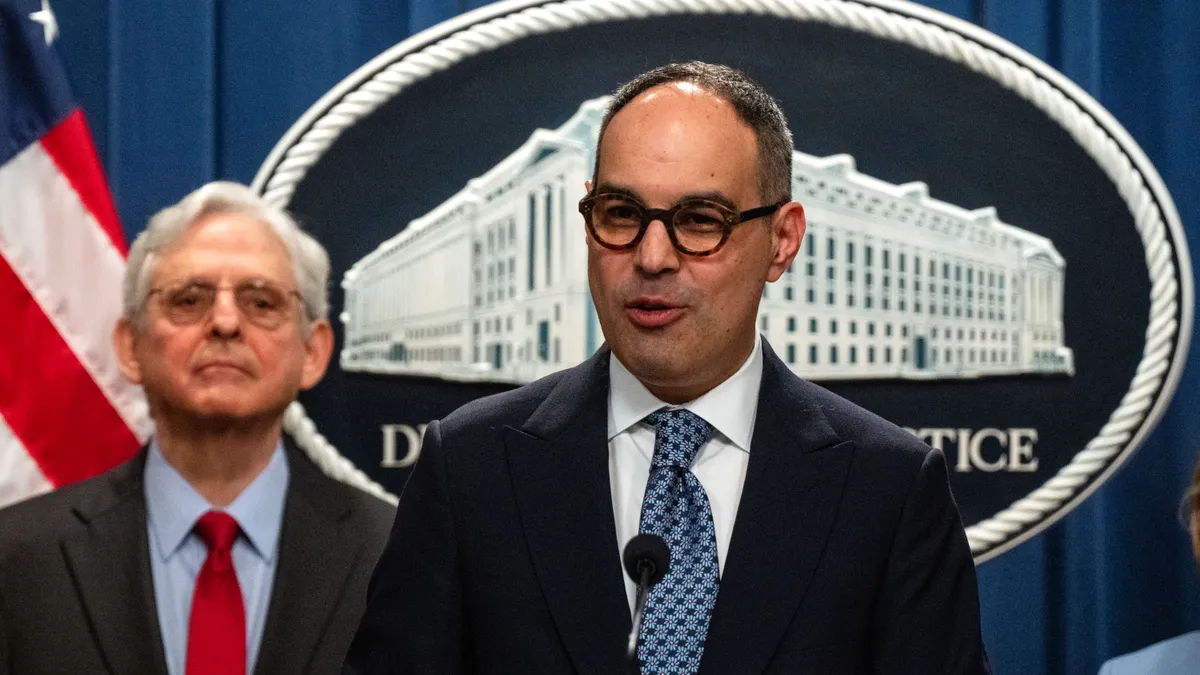
Sens. Roger Marshall, a Republican, and Dick Durbin, a Democrat, reintroduced their Credit Card Competition Act proposal Tuesday, resurrecting their years-long effort to make a card processing network other than Visa and Mastercard available to merchants whenever consumers swipe their credit cards.
The two networks have long dominated the industry in working with major banks that issue the cards.
Under the bill, banks that issue credit cards would have to ensure that for every consumer swipe there was a network available to merchants for routing the payment that wasn’t Visa or Mastercard. The idea would be to give merchants at least one alternative, injecting additional competition into a market the two networks dominate.
The mandate would apply to card issuers with assets of $100 billion or more.
The bipartisan duo rounded up support for the bill last year from retailers and restaurants eager to reduce the interchange fees they must pay when consumers choose to use credit cards. The senators aimed to attach the legislation to bills that had more momentum in recent years, but were unsuccessful.
Now, it could move forward with support from the Republican president who just this week also called for lower interest rates for consumers who use credit cards.
“Everyone should support great Republican Senator Roger Marshall’s Credit Card Competition Act, in order to stop the out of control Swipe Fee ripoff,” Trump said in a post on his Truth Social media site. “Roger is a FANTASTIC Senator!!!”
A press release from Durbin’s office announcing the reintroduction of the legislation repeated the senator’s long-time contention that Visa and Mastercard have a “duopoly” in the market, controlling about 85% of the processing.
Passage of the act would “increase competition in the credit card market and put an end to the Visa-Mastercard duopoly that is squeezing small businesses,” Durbin’s release said.
In the House, Texas Republican Rep. Lance Gooden and Rep. Zoe Lofgren, a California Democrat, introduced a similar bill on Tuesday, reviving a measure they introduced in June 2023. “Credit card companies have been raking in record profits at the expense of Main Street America,” Gooden said in a press release.
The Electronic Payments Coalition, which counts Visa and Mastercard as members, issued a press release assailing the bills as a “big government takeover of the credit card system.”
A Mastercard spokesman referred a request for comment to the EPC. Visa did not immediately respond to a message seeking comment.
“Study after study from respected economists, academics, independent think tanks, and even nonpartisan government agencies show these untested mandates will not lead to lower prices,” Richard Hunt, the coalition’s executive chairman, said in the release.
Rather, he added, the legislation would “line the pockets of corporate mega-stores while hurting Main Street small businesses, eliminating the credit card rewards Americans rely on to make everyday purchases more affordable, weakening the security and data protections consumers expect, and harming local economies by reducing tourism and limiting access to credit.”
Trump’s support of the credit card legislation – four days after calling for a 10% cap on card interest rates for one year – comes as the administration grapples with how to make everyday expenses more affordable ahead of midterm congressional elections later this year.
The credit card competition bill would pass Congress if it were able to reach a vote, predicted Doug Kantor, an executive with the Merchant Payments Coalition and general counsel of the National Association of Convenience Stores. Both organizations have battled card networks over swipe fees for years.
The average U.S. family pays $1,200 each year in higher prices due to “the broken credit card system,” the MPC said Tuesday in a press release praising the bills’ reintroduction.
Trump’s support, coupled with negative public opinion on credit card fees, is likely to help sway members of Congress on the issue, Kantor said Tuesday in a telephone interview.
“A Republican president endorsing a bill in a Republican Congress is always a good thing and this particular president has more sway over the Congress than just about any in recent memory,” he said. “So I think it bodes very well for the prospects for the bill.”
On Monday, Trump called Democratic Sen. Elizabeth Warren to discuss topics related to affordability, the Massachusetts senator told reporters. She said she told Trump that a 10% cap on credit interest would pass “if he will actually fight for it,” NBC News reported.
Senators Bernie Sanders and Josh Hawley introduced a bill last February that would freeze credit card interest rates at 10% for five years. The proposal echoed one that Trump suggested in 2024 as he ran for a second term in the White House.
Both credit card proposals face fierce opposition in Congress from members of Trump’s own party, Politico reported Tuesday, citing interviews with Republican leaders in both chambers.