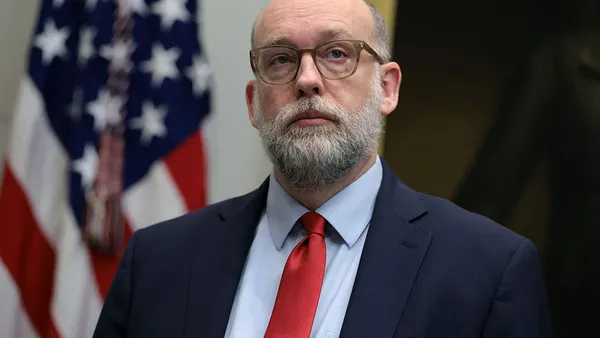
As the Consumer Financial Protection Bureau faces a self-imposed budget lapse, its acting director’s refusal to seek new funding has become a point of contention in two federal lawsuits that seek to prevent the shuttering of an agency that regulates many payments areas.
Last month, the CFPB told a federal court that the Justice Department’s Office of Legal Counsel had determined it could not “lawfully draw funds” from the Federal Reserve. Absent a request for money – or a separate appropriation from Congress – the CFPB is expected to run out of funding early next year.
The decision by Acting Director Russell Vought not to seek operating funds drew a lawsuit on Friday, with three nonprofit public interest groups suing Vought and the CFPB in federal court in San Jose, California.
The National Community Reinvestment Coalition, Rise Economy and Woodstock Institute are asking a judge to compel the bureau to request funding.
“Vought’s new theory attributes to Congress an irrational scheme in which supervision of our nation’s largest financial institutions starts and stops based on the CFPB’s assessment of Fed finances,” Stephanie Garlock, an attorney with Public Citizen’s litigation group and a lawyer for the plaintiffs, said Friday in a press release from that nonprofit.
The bureau’s refusal to seek funds “will cause substantial disruption” to financial institutions and consumers, added Garlock, a former CFPB lawyer.
Under the administration of President Joe Biden, the bureau had increasingly sought to regulate payments areas such as buy now, pay later lending, earned wage access providers and digital wallets. The Trump administration has repeatedly criticized the agency and has sought to dismantle it, with Vought saying in October that the bureau would be shuttered within three months.
Meanwhile, in Washington D.C., the National Treasury Employees Union asked U.S. District Judge Amy Berman Jackson last month to clarify a preliminary injunction she issued in March. The employees want the court to prevent CFPB leaders from shuttering the agency, also fighting the decision not to request new funds from the Federal Reserve.
In its response Monday, the CFPB asked Jackson not to order it to request funds or, if she does, to stay the ruling pending an appeal.
“Citing this manufactured fiscal crisis, Defendants have begun to take steps to shut down the agency altogether, including transferring away active litigation and developing plans to furlough staff en masse,” the nonprofits said in their complaint.
On Friday, five former Federal Reserve officials filed a “friend of the court” amicus brief, including Donald Kohn, a former Fed vice chairman from 2002 to 2010. The brief explained funding flows at the central bank and sought to undercut the financial rationale for defunding offered by the CFPB.
The Federal Reserve Board of Governors works with the bureau on coordinating examinations and adjusting thresholds in consumer regulations. It also coordinates with the agency on data the CFPB publishes on home mortgages, the brief said.
“The system envisioned by the [Justice Department’s] OLC opinion — in which the CFPB is intermittently defunded during times of economic flux — would undermine the Federal Reserve’s ability to carry out its own consumer protection work by mothballing an important partner in that work,” the former Fed official wrote.
“If courts follow the law, they’ll continue rejecting these ridiculous efforts to make it easier to cheat American families,” Sen. Elizabeth Warren, a Massachusetts Democrat, said in a statement Saturday about the bureau’s legal gambit.