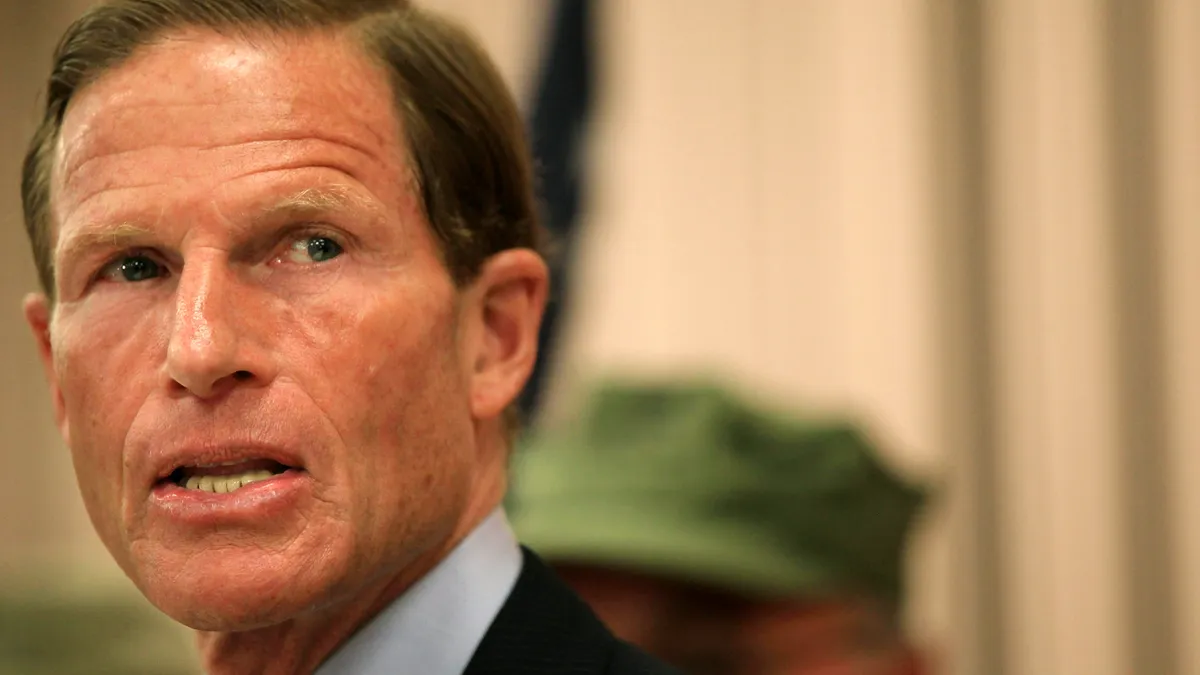
Sens. Dick Durbin and Roger Marshall are once again plotting a path for passing their Credit Card Competition Act, a bill that aims to give Visa and Mastercard more competition.
The senators are angling to attach the legislation to a major housing bill, the 21st Century ROAD to Housing Act, poised to land on the Senate floor for a vote this week or next. That bipartisan-backed housing bill could afford Marshall, a Republican from Kansas, and Durbin, a Democrat from Illinois who isn’t running for office again, a vehicle for advancing the bill if amendments are allowed.
The timing is unclear, but sponsors of the housing bill, Sens. Tim Scott (R-SC) and Elizabeth Warren (D-Mass.), are aware of the Marshall-Durbin desire to offer an amendment, said Doug Kantor, who has advocated for the CCCA as general counsel for the National Association of Convenience Stores. Warren has previously supported capping credit card fees.
“I think [Scott and Warren] are fully aware that the sponsors of the CCCA will take any opportunity that is presented to them,” Kantor said in an interview Wednesday. “We’re sort of waiting to hear.”
A spokesperson for Durbin’s office didn’t immediately respond to a request for comment.
”Senator Marshall has always fought for Main Street over Wall Street, and his Credit Card Competition Act would break up the Visa-Mastercard duopoly and lower the hidden swipe fees that drive up prices for American families,” Marshall’s communications director, Payton Fuller, said by email. “These fees are baked into everyday purchases and are estimated to cost consumers 1–2% more on essentials like gas and groceries,” he contended.
Marshall and Durbin have been pushing the legislation for several years, after teaming up in 2022. They also tried to attach it last year to the Genius Act, a bill that passed and allowed for a regulatory structure for stablecoins.
The legislation would help retailers, restaurants and other merchants by forcing banks that issue credit cards to make sure there was an alternative to Visa and Mastercard available for processing credit card transactions.
Visa, the largest U.S. network, and No. 2 Mastercard, dominate the industry, controlling about 77% of the market in the U.S. credit card market, according to the research firm Nilson Report. The card networks receive a slice of the fees that are paid by merchants every time a consumer swipes a credit card.
Durbin and Marshall reintroduced the CCCA bill in January after President Donald Trump backed the legislation in a social media post that praised Marshall and called interchange “Swipe Fee ripoff.” Trump has backed their bill alongside a bid to cap credit interest rates as well.
Nonetheless, banks have long fought any campaigns to reduce the fees that they and the card networks reap from card transactions. They’ve dug in on the current CCCA battle.
The Electronic Payments Coalition, which represents banks and networks, lambasted the latest effort to move forward the CCCA bill, which it calls a “credit card mandate.”
“Groundhog Day might have been last month, but Senators Durbin and Marshall are replaying the same failed script – desperately trying to jam their economy-crushing credit card mandates onto any bill moving through Congress,” EPC Executive Chairman Richard Hunt said in a statement Tuesday.
The other side is up for a fight. Marshall and Durbin are “open to any opportunity to get a vote and feel like the banks can’t duck this vote forever,” Kantor said.