Diners may increasingly spot dual pricing options on their tabs as some restaurants begin offering discounts for cash payments in a bid to reduce the credit card fees they pay to issuers and networks.
Some have likely begun surcharging, said Vanessa Sink, a National Restaurant Association spokesperson, noting the swift introduction of temporary surcharges for eggs early this year as prices surged. The association doesn’t query restaurants about payment surcharging or discounts as part of its monthly survey, she said.
“When everything starts to go up, you have to do something and all of them are making different decisions about what they think their diners will accept,” Sink said, noting a wide diversity of 70 different segments within the restaurant industry.
Merchants’ long battle with card networks Visa, Mastercard and American Express over interchange fees is seeping into financially-pinched restaurants, forcing them to impose surcharges, said Doug Kantor, general counsel of the National Association of Convenience Stores and a longtime legislative advocate against card fees imposed by card companies.
Last month, the Texas Restaurant Association began encouraging diners to pay with cash or debit cards as a way to help reduce restaurants’ interchange expenses.
“It’s really a sign of desperation,” Kantor said Wednesday in an interview about restaurants’ dual pricing. “The fees have gone up more than 70% since COVID, which is just an unsustainable pace for restaurants and other retailers.”
Card fees are typically the third-highest expense for a restaurant, after food and employee wages, according to the National Restaurant Association.
“Adding a surcharge for credit card swipe fees could be how restaurant operators are choosing to be more transparent with their customers about their rising costs of accepting credit cards, instead of just raising menu prices, which customers typically watch closely,” Sink said.
The National Restaurant Association and the Merchant Payments Coalition are planning a two-hour “swipe fee merchant bootcamp” next week to prepare restaurant operators for 2026 legislative work.
The restaurant industry has been beset with a variety of ills this year, he noted. Higher food prices and labor costs have combined with traffic declines for many restaurants as persistent U.S. inflation has curbed many Americans’ dining and entertainment budgets. Through October, restaurants have reported nine consecutive months of traffic declines, according to the National Restaurant Association.
A 2024 survey by the association found that only 16% of members had surcharges, Sink said. In addition to surcharges for card fees, the figure also includes surcharges for large groups and delivery fees.
The association and the merchant coalition do not have 2025 data on the prevalence of restaurants breaking out their card fee expense with dual pricing, a practice which has become common at gas stations and some other retailers.
Interchange fees reached a record $187.2 billion last year, or about $1,200 for the average family, the payments coalition said Tuesday in a news release.
Representatives for Visa and Mastercard declined to comment specifically on the issue but pointed to their merchant surcharging rules, which note that surcharges may not be applied to debit cards.
“Before choosing to surcharge, you may want to consider a number of factors,” Visa says in a question and answer document for merchants. Those include “the potential impact on your customer’s experience” and what competitors may be doing.
Several states, including Connecticut and Massachusetts, prohibit credit card surcharges, while others such as Minnesota and New York have regulated how merchants surcharge, Visa notes in its Q&A.
American Express did not respond to an email Wednesday seeking comment about restaurant card fees’ pricing.
Amano Bistro, an Italian restaurant on Chicago’s North Side, began offering cash and non-cash prices this summer following a suggestion by the restaurant’s point-of-sale platform provider, Shift4 Technologies, manager Nick Menicanin said Wednesday.
Diners rarely notice and don’t care about the restaurant’s dual prices, he said. “It totally doesn’t matter because 99.9% of the people pay with credit cards,” Menicanin said. “I rarely see cash in the restaurant.”
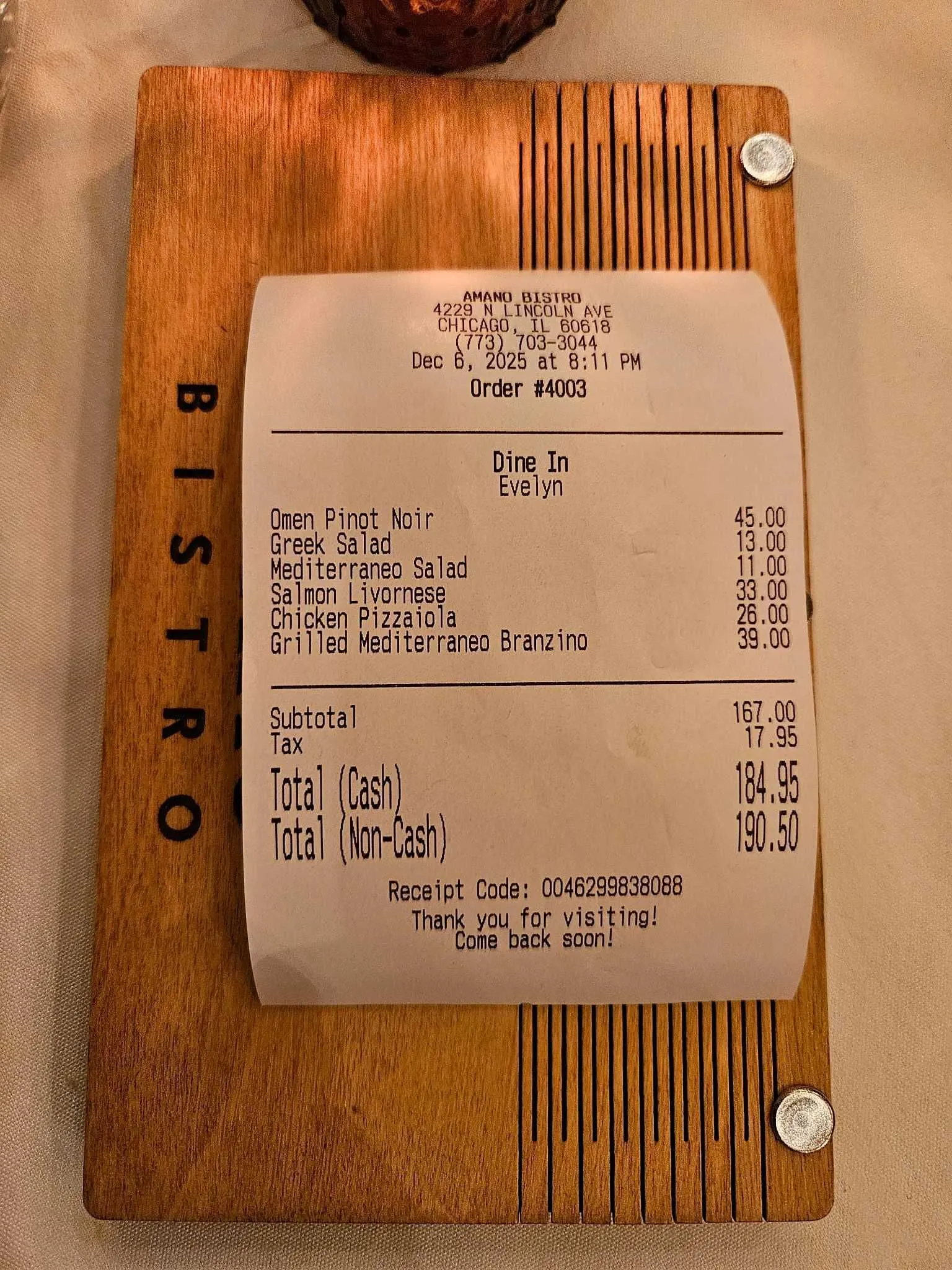
A higher price for a card payment is a “normal” trend that most customers are aware of and “many, many, many restaurants in Chicago do it,” he said. “I have to protect myself and protect the customer so they know what they’re paying for.”
A Shift4 spokesperson did not respond to a request for comment.
In its Nov. 25 press release, the Texas Restaurant Association said “it’s not uncommon” for credit card companies to make more money from a dining tab than the restaurant. “These hidden fees have increased by more than 50% in the past five years and now siphon more than $10 billion a year out of Texas’ economy,” the association said
Restaurants are likely reluctant to begin detailing their card expense on bills explicitly because of the potential for “consumer backlash,” Kantor said.
Beyond merchants’ decades-long fee litigation against Visa and Mastercard, they are also pressing Congress to curb card swipe fees via the proposed Credit Card Competition Act. The bill has flailed for several years, and one of its sponsors, Sen. Dick Durbin, a Democrat from Illinois, has only one year left in the Senate before his planned retirement.
Correction: This story has been updated to correct comments about the National Restaurant Association's monthly survey, eliminating an erroneous piece of context. It was also updated to add information clarifying the survey's statistic about surcharging. In addition, it was updated to remove a comment attributed to Sink.